Lactic Acid vs Citric Acid vs Glycolic Acid: Which Organic Acid Belongs in Your Formulation?
Lactic acid, citric acid, and glycolic acid—as organic acids—have long been more than just pH regulators in modern cosmetics and home care development. They are multifunctional tools that combine cleansing power, skin care, preservative support, and sustainability in a single raw material. But anyone looking to optimize a formulation quickly faces a fundamental question: Which acid offers the best balance of efficacy, safety, and environmental impact for a given purpose?
A recent comparative study has systematically addressed this question, evaluating three of the most important alpha-hydroxy acids (AHAs) across six performance dimensions. We’ve summarized the results for you and highlight which insights can be directly translated into practical formulations. At Cosmacon, we see ourselves as a neutral, independent source of knowledge: The following evaluation of lactic acid, citric acid, and glycolic acid is manufacturer-independent and is intended to provide you, as a formulator, with a sound basis for decision-making.
Why Organic Acids Are the Market of Tomorrow
The industry faces a twofold challenge: stricter regulations from the ECHA and increasingly critical consumers who demand transparency, biodegradability, and gentle ingredients. Organic acids meet both of these requirements. They are biodegradable, can be derived from renewable raw materials, and offer a favorable safety profile with a broad spectrum of functions.
The problem in practice: Most available data examines a single acid or a single property in isolation. A direct, multidimensional comparison has been lacking until now. The study discussed here closes precisely this gap by simultaneously evaluating sustainability, regulatory compliance, antimicrobial activity, skin hydration, skin irritation, and descaling performance.
An Overview of the Physicochemical Properties of Lactic Acid, Citric Acid, Glycolic Acid
Before we delve into their applications, it’s worth taking a look at the basic substance data. These explain a large part of the performance differences that will be discussed later.
| Parameter | Lactic Acid | Citric Acid | Glycolic Acid | |
|---|---|---|---|---|
| Molecular weight (g/mol) | 90.08 | 210.14 | 76.05 | |
| pKa (first relevant value) | 3.86 | 3.13 | 3.83 | |
| Origin (typical) | Fermentative, bio-based | Fermentative, bio-based | Predominantly petrochemical | |
| Carbon footprint (kg CO₂-eq/t) | 86 – 367 | 1,394 – 4,700 | 2,982 – 3,553 | |
| Relation to skin NMF | Lactate is an NMF component (~12%) | not in NMF | not in NMF |
Three points are particularly relevant for formulators:
First, the molecular weight: At just 76 g/mol, glycolic acid is the smallest molecule and penetrates deeper into the skin, which increases both its efficacy and its potential for irritation.
Second, the pKa value, which determines the pH range in which the acid is protonated (and thus antimicrobial) or dissociated.
Third, the origin: While lactic acid and citric acid are produced through fermentation and are bio-based, glycolic acid is typically derived from petrochemical processes, which is clearly reflected in its carbon footprint.
Sustainability: A Clear Winner
The life cycle assessment (LCA according to ISO 14040/14044) paints a clear picture. Lactic acid has by far the lowest carbon footprint, at 86 to 367 kg CO₂-eq per metric ton. Citric acid is significantly higher, though the region of production plays a major role: When produced in Europe (around 1,394 kg CO₂-eq/t), it performs better than glycolic acid; when produced in Asia (up to 4,700 kg CO₂-eq/t), its footprint exceeds that of the petrochemical alternative. The reason lies in the energy mix and the differing environmental and safety standards.
For sustainability-oriented brands, this means: If you want to minimize your ecological footprint, there’s hardly any way around lactic acid. For citric acid, the origin should be actively inquired about and documented.
Regulations and Labeling: Where the Differences Matter
All three acids are registered for typical disinfection applications (biocidal product types PT2, PT3, PT4) and are largely interchangeable in this context. The distinction becomes crucial when more specific claims come into play.
- Lactic acid also has registrations for PT1 (human hygiene) and PT6 (pot preservation). This makes it the only one of the three that can be used for preservation and human hygiene claims.
- Citric acid has an additional PT5 registration (drinking water disinfection).
- In terms of labeling, citric acid has an advantage: at a pH above 2 and a concentration below 10%, it is classified as less irritating to the eyes and skin, whereas lactic acid and glycolic acid tend to entail stricter labeling requirements under comparable conditions.
So anyone seeking a product with minimal labeling and hazard warnings will find a pragmatic solution in citric acid.
Skin Tolerance and Hydration: The Skincare Aspect
This is where lactic acid demonstrates its greatest strength. In dermatological tests, it was the least irritating across all pH values tested (3, 5, 7). The reason lies once again in the molecular weight: The smaller glycolic acid molecule penetrates deeper and is more irritating even at lower concentrations. Citric acid, on the other hand, is primarily irritating due to its concentration, as its weight percentage is significantly higher at the same molarity.
Lactic acid also leads in terms of hydration: Above its pKa, it is predominantly present as lactate, an established, endogenous moisturizing factor that accounts for about 12% of the skin’s natural moisturizing factor (NMF). In short-term tests, hydration lasted six to eight hours at pH 5 to 7, significantly longer than with the other two acids. Even in long-term use over six weeks, it demonstrated a significant, sustained improvement in skin moisture. Citrate and glycolate, on the other hand, are not NMF components and are therefore weaker moisturizers.
Antimicrobial Effect: pH Is the Deciding Factor
Tested according to EN 1276:2019 under “dirty conditions” with only one minute of contact time, a clear pattern emerged. At pH 3.5, lactic acid achieved complete elimination of all four test bacteria even at a concentration as low as 0.05%. It was particularly effective against the Gram-negative E. coli: While the other two acids showed weaknesses here even at higher concentrations, lactic acid reliably achieved complete reduction.
The mechanistic background: lactic acid destabilizes the outer membrane of Gram-negative bacteria particularly effectively, especially in combination with surfactants. Glycolic acid, on the other hand, requires strongly acidic conditions (pH 3) for optimal effectiveness, while citric acid acts primarily through the cell wall and shows gaps in efficacy at short contact times. If the pH rises to 4, all three acids must be used at significantly higher concentrations (1 to 1.5%) to reliably inactivate Gram-negative bacteria.
Practical implication: An acidic pH is essential for reliable, broad-spectrum antimicrobial activity at low concentrations, and lactic acid offers the greatest robustness in this regard.
Descaling: Concentration Makes the Difference
In the Marble Block Test, the acids behaved differently depending on their concentration. At low concentrations (1%), all three performed equally. With 2.5%, glycolic acid achieved the strongest effect in the short term. At 5% and above, however, the picture reversed: citric acid and glycolic acid plateaued, while lactic acid continued to increase linearly and, at 7.5 to 10%, significantly outperformed the other two. This is due to the high solubility of calcium lactate, which prevents surface passivation.
For high-dose descaling agents (baths, sanitary applications), lactic acid is therefore the most efficient choice; for mild cosmetic applications, low concentrations are sufficient, at which the differences remain minimal.
What does this mean for cosmetic formulations?
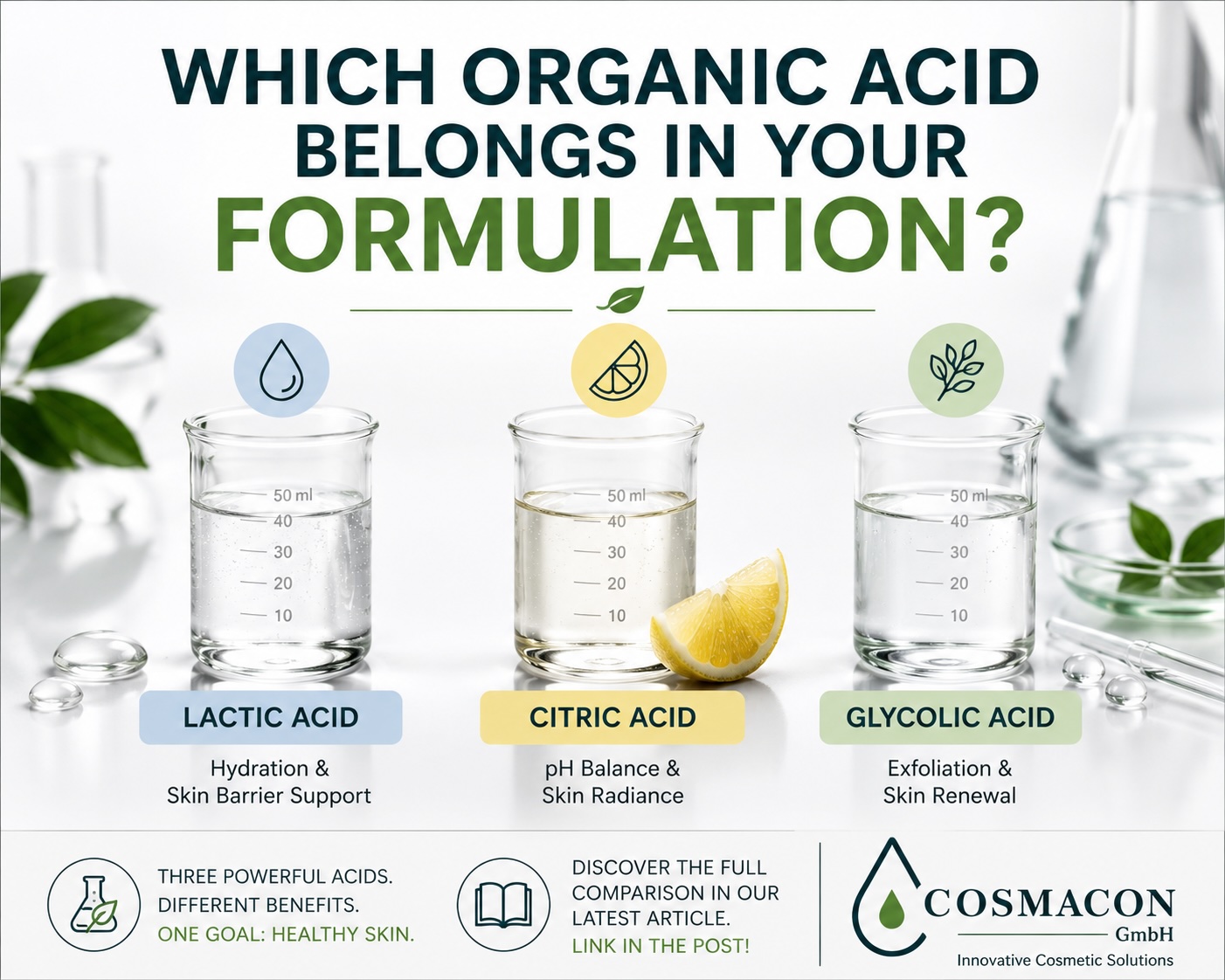
The key finding: There is no single “winner,” but rather a clear division of roles. Lactic acid is the most versatile all-rounder with the best profile in terms of sustainability, hydration, low irritation, and antimicrobial safety. Citric acidscores points for its low labeling requirements and is ideal as a pH regulator and chelator. Glycolic acid provides the most intense exfoliation and a strong short-term descaling effect, but is limited by its petrochemical origin and higher irritation potential. In modern formulations, the acids can also be effectively combined.
6 Product Ideas with Lactic Acid, Citric Acid, Glycolic Acid
For inspiration for your product pipeline, each featuring at least one of the three acids:
- Gentle AHA Hydrating Serum – Base: lactic acid (0.5–2%) at pH 4.5–5. Combines mild exfoliation with long-lasting hydration via the lactate-NMF effect. Target audience: sensitive and dry skin.
- Glow Exfoliating Pads for Nighttime Use – Base: glycolic acid (5–7%) combined with lactic acid as a buffering, soothing component. The smaller glycolic acid molecules provide visible texture refinement, while lactic acid reduces the potential for irritation.
- Micellar Cleansing Gel with a Freshness Boost – Base: citric acid as a pH regulator (target pH ~5) plus lactic acid (0.1%) for subtle antimicrobial support. Minimal labeling requirements thanks to citric acid’s favorable labeling profile.
- pH-balanced intimate wash foam – Base: lactic acid at a low pH (3.5–4). Takes advantage of its physiological similarity to the skin’s natural environment and its effectiveness against Gram-negative bacteria; PT1 registration supports hygiene claims.
- Anti-pigment toner for an even complexion – Base: glycolic acid (low dose) for cell renewal, supplemented by lactic acid for hydration and tolerability. For mature skin or skin prone to uneven pigmentation.
- Long-lasting Bath and Limescale Cleaner (Home Care) – Base: high-dose lactic acid (7.5–10%). Thanks to superior calcium lactate solubility, it delivers the most powerful descaling action while also boasting the lowest carbon footprint.
Conclusion: Function Over Dogma
Choosing the right organic acid isn’t a matter of faith, but rather a function of the desired profile. Those who prioritize sustainability, skincare, and antimicrobial safety will find lactic acid to be the most robust choice. Those looking for a product with minimal labeling and a clean pH should opt for citric acid. And those who need maximum exfoliating power can’t do without glycolic acid—but should be aware of its limitations.
Cosmacon develops customized, regulatory-compliant formulations for you that balance efficacy, skin tolerance, and sustainability—independently and transparently. Talk to our formulation experts →
No budget or time for in-house development? Tojo Cosmetics offers ready-to-use white-label products to help you get a quick start in the market.
Discover now: www.tojocosmetics.de/produkte
Frequently asked questions (FAQ)
Which of the three acids is the most skin-compatible?
Lactic acid was the least irritating across all studied pH values (3, 5 and 7) in dermatological testing. Glycolic acid irritates more strongly even at lower concentrations due to its lower molecular weight, while citric acid irritates mainly through concentration.
Which organic acid has the lowest carbon footprint?
Lactic acid, at 86–367 kg CO₂-eq per tonne. Citric acid is considerably higher and strongly dependent on production region; glycolic acid is predominantly petrochemical at 2,982–3,553 kg CO₂-eq per tonne.
Why does lactic acid perform better against Gram-negative bacteria such as E. coli?
Lactic acid destabilises the outer membrane of Gram-negative bacteria particularly effectively, especially in combination with surfactants. In EN 1276:2019 testing it achieved complete kill from 0.05% at pH 3.5, whereas citric acid and glycolic acid showed gaps.
Which acid is suitable for preservation or hygiene claims?
Only lactic acid is additionally registered for PT1 (human hygiene) and PT6 (in-can preservation). All three acids can be used for disinfection applications (PT2, PT3, PT4); citric acid additionally holds PT5 (drinking water).
Which acid is strongest at descaling?
It depends on concentration. At 2.5%, glycolic acid leads short-term. From 5% upward, lactic acid clearly outperforms the other two, because calcium lactate is highly soluble and forms no passivating layer.
Literature:
This article is based on a published comparative study (E. Lansdaal, SOFW Journal 5/26).