Beta-Glucan: Mechanisms of Action, Research Evidence, and Use in Cosmetics
Chronic, low-grade inflammation is now considered one of the key risk factors for many everyday ailments—triggered by highly processed foods, lack of exercise, stress, lack of sleep, or being overweight. One natural substance that is gaining increasing attention in this context is beta-glucan. The market for related dietary supplements in Europe was already estimated at around $40.7 billion in 2023, and more than half of European consumers specifically use supplements to maintain their health.
However, “beta-glucan” is not a uniform term. Depending on its origin, structure, and degree of purity, its effects and areas of application vary considerably. This article explains what lies behind the term, what study results are available, and where the molecule can also be usefully applied in cosmetics.
What exactly is beta-glucan?
Chemically speaking, it consists of polysaccharides derived from glucose—that is, long-chain sugar molecules. What makes this group of substances so heterogeneous is their respective architecture: The type of bonds, degree of branching, solubility, particle size, and molecular weight significantly determine how a beta-glucan acts in the body. These structural differences are the reason why study results for a specific preparation cannot be readily applied to other products.
Structural Differences: Grains versus Yeast
A particularly relevant difference lies in the source of the raw material:
Grains (oats, barley): These predominantly feature a linear β-(1→3)(1→4) bond structure. This form is best known in the context of dietary fiber. Its effects are often explained by its gel-forming properties and tend to affect metabolism-related parameters—for example, in the intestine, where it acts through viscosity.
Yeast (Saccharomyces cerevisiae): Here, a β-(1→3) backbone structure with long β-(1→6) branches dominates. This architecture is considered particularly relevant for immunological and anti-inflammatory processes, as such structures can be recognized by the innate immune system.
| Source | Typical Structure | Effect |
|---|---|---|
| Cereals (oats, barley) | predominantly linear β-(1→3)(1→4) | Primarily physical effects in the intestine (solubility/viscosity) → primarily metabolic parameters |
| Yeast | mostly a β-(1→3) backbone with long β-(1→6) branches | Tends to interact with the innate immune system (receptor recognition; structure and particle shape are relevant) |
Standardized preparations made from brewer’s yeast (Saccharomyces cerevisiae) contain 80–90% of the active substance with a high degree of purity. They are usually available as a spray-dried, tasteless, and odorless powder and do not contain live cultures—an advantage for process stability and formulation. In the EU, these raw materials are authorized as novel foods; in the U.S., they generally have GRAS status.
Mechanisms of Action: How Does It Work in the Body?
Yeast supplements taken orally do not act like traditional anti-inflammatory drugs. Instead, they are recognized in the gut as a typical microbial pattern—by gut cells and immune cells. This triggers signals that influence the release of messenger substances. The direction of this shift is crucial: IL-6, TNF-α, and CRP tend to indicate an inflammatory response, while IL-10 is associated with regulation.
Another explanatory model is the “trained” innate immune system: after initial contact, immune cells respond more coordinately to subsequent stimuli, with structure and manufacturing quality playing a decisive role. This mechanism could explain why milder disease courses or fewer episodes of the common cold were observed in clinical trials.
What Study Results Show About Beta-Glucan
Human studies: In a controlled, double-blind study, four weeks of supplementation led to a significant increase in IL-10 levels in the blood and in gene expression in adipose tissue, while pro-inflammatory markers remained unchanged—suggesting enhanced anti-inflammatory regulation without general immunosuppression.
In an exercise model (intense endurance exercise under heat and humidity stress), lower levels of several pro-inflammatory chemokines and cytokines—including IL-8, MCP-1, and MIP-1β—were observed during the recovery phase after just under two weeks of supplementation.
Two larger studies on adults with recurrent colds are particularly relevant to clinical practice: At a dosage of 900 mg/day over 16 or 26 weeks, the number and severity of symptomatic colds as well as sleep-related disturbances decreased, as did typical symptoms such as sore throat, hoarseness, and a runny nose. A systematic review from 2021, which synthesized 24 randomized studies, confirms: The strongest body of evidence pertains to colds and respiratory infections with milder, shorter episodes.
Conclusion on Health Effects
Overall, a consistent picture emerges: Various models show a strengthening of anti-inflammatory regulation, particularly via IL-10, combined with a tendency toward a reduction in pro-inflammatory markers. In this context, “immunomodulatory” means that the immune response is balanced rather than unilaterally suppressed—although the origin, structure, and degree of purity of the respective preparation are decisive in determining whether study results can be generalized at all.
Beta-Glucan in Cosmetics: Six Product Ideas
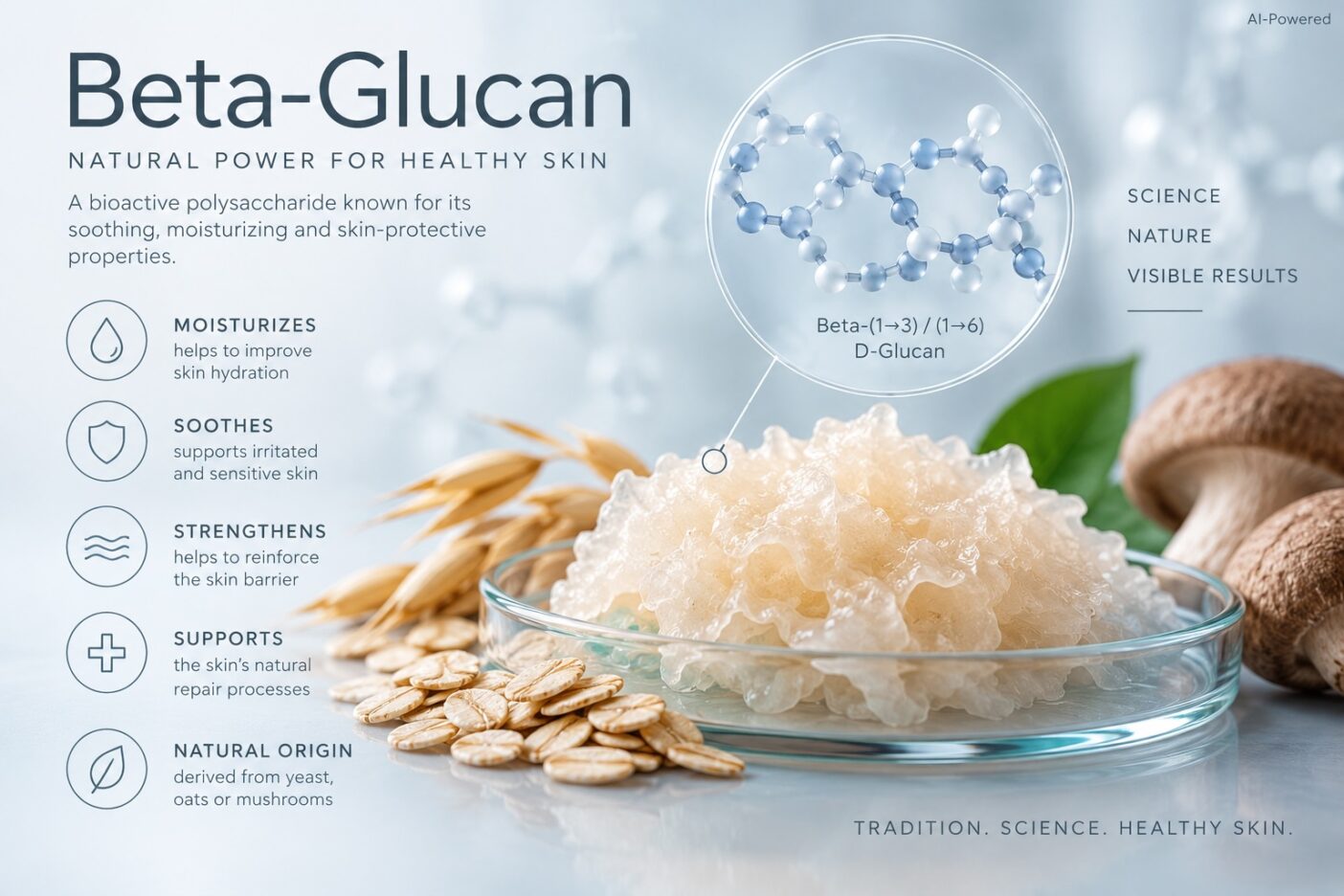
In addition to internal use as a dietary supplement, the molecule is also increasingly gaining attention for external application. It is considered to be moisture-binding, skin-soothing, and barrier-supporting—properties that can be utilized in various product categories:
- Moisturizing cream for sensitive skin—its film-forming and water-binding properties support the skin’s natural moisture balance and can provide a soothing sensation.
- Anti-aging serum—combined with hyaluronic acid or antioxidants as a complement in formulations designed to promote a smoother, firmer complexion.
- After-sun and repair lotion—for products designed to soothe irritated or stressed skin after sun exposure.
- Soothing mask for reddened or irritated skin—for example, as a weekly treatment for skin prone to redness or irritation.
- Leave-in treatment for hair and scalp – to help maintain a balanced scalp sensation, especially in formulations for sensitive or irritated scalps.
- Eye care gel or cream – for the particularly thin skin around the eyes, combined with other nourishing active ingredients to promote a fresh, well-rested appearance.
Just as with oral use, the exact origin and purification of the raw material used are crucial for cosmetic applications, since the structure and particle shape also significantly influence how the molecule interacts with the skin.
From Active Ingredient to Finished Product: Two Paths
Those who wish to incorporate the ingredient into their own cosmetic product generally have two options:
Custom formulation development with Cosmacon: For brands that want to develop a tailor-made formulation with a precisely balanced combination of active ingredients, texture, and fragrance, Cosmacon guides them every step of the way—from formulation and manufacturing to the finished, market-ready product.
Get started right away with white-label products from Tojo Cosmetics: Those who want to get started faster can rely on pre-developed, tested products. Tojo Cosmetics offers an extensive range of white-label products that can be launched under your own label within a few weeks rather than months—successful products can be further customized later.
Conclusion
The term “beta-glucan” refers to a structurally diverse group of substances whose effects depend heavily on their source and purification process. While cereal-based sources primarily exert their effects through physical mechanisms in the gut, standardized yeast-based variants have shown consistent evidence in animal and human studies of balanced immune and inflammatory regulation—particularly in the context of colds, stress, and obesity. In cosmetics as well, the moisture-binding and skin-soothing properties open up promising areas of application, provided the quality and standardization of the raw material are appropriate.
References:
Schulenberg, M. (2025). “Anti-inflammatory Stimuli for Immune and Inflammatory Regulation.” Vitalstoffe, April 2025, pp. 12–16. Additional references available from the author.