Autophagy in Skincare: The Trend Toward Cellular Self-Cleansing
Ever since Yoshinori Ohsumi was awarded the 2016 Nobel Prize in Medicine, autophagy has been a key concept in basic research—and at the 2026 active ingredient trade shows, it has finally made its way into the cosmetics industry under the hashtag #Autophagy. The principle of cellular self-cleansing is becoming a key selling point, particularly in concepts related to longevity, regeneration, and hair growth. This article provides an objective overview of autophagy in skincare.
What is autophagy?
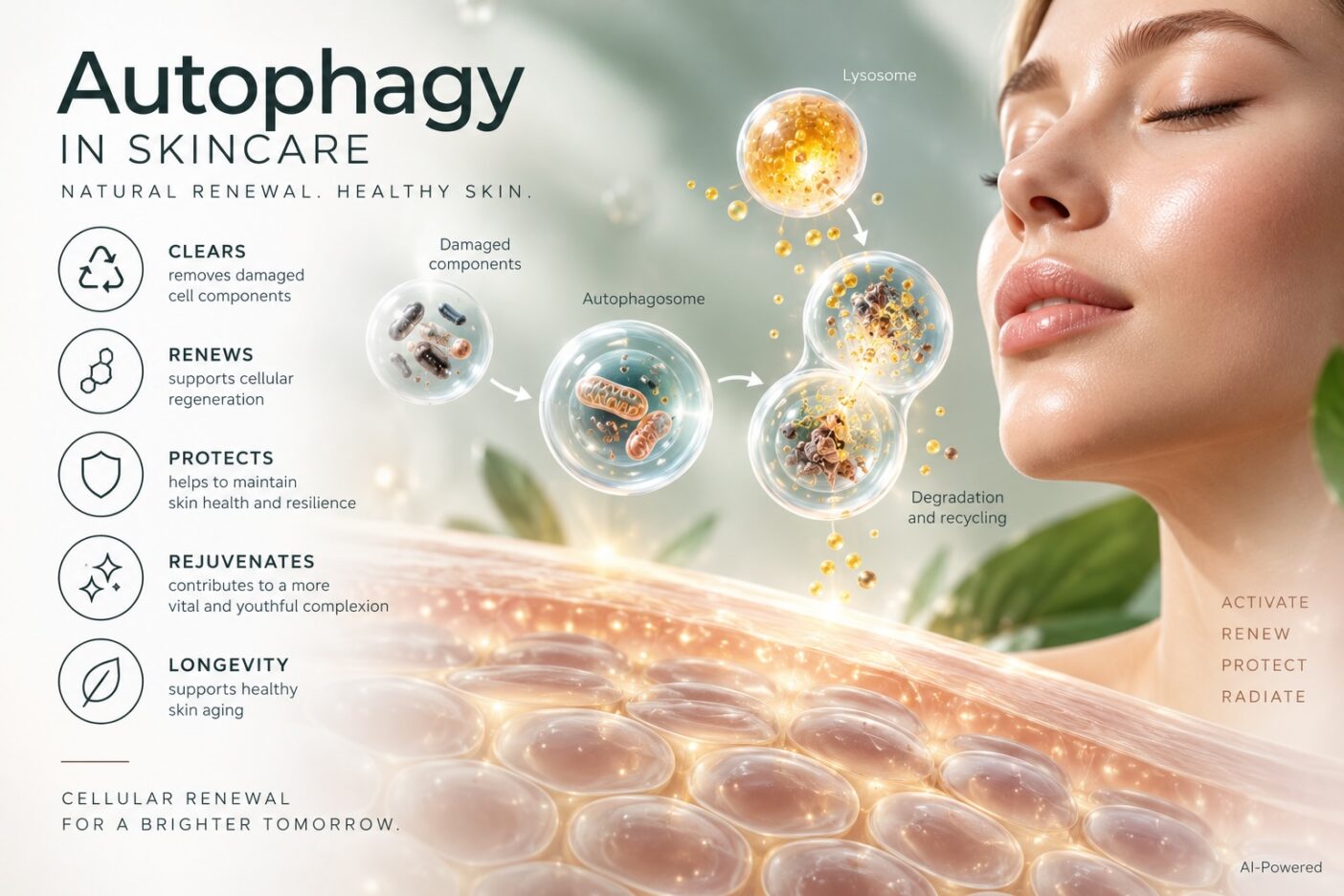
Autophagy (“self-eating”) is a natural recycling process within the cell. Damaged proteins, misfolded molecular aggregates, and spent organelles are enclosed in membrane vesicles (autophagosomes), transported to the lysosomes, and broken down there. The building blocks are then made available again. The cell thus disposes of its “cellular waste” and recovers new resources from it.
This process is a central quality-assurance mechanism. If it runs smoothly, cells remain functional; if it declines, damaged structures accumulate—a hallmark of cellular aging.
Why Autophagy Is Relevant to Skin Aging
Autophagy activity declines with age and under chronic stress. In the skin, this has specific consequences:
- Keratinocytes: A functioning self-cleaning process supports orderly differentiation and thus an intact stratum corneum and skin barrier.
- Fibroblasts: Autophagy helps remove oxidatively damaged proteins and is associated with maintaining collagen and matrix quality.
- Melanocytes: The process is involved in regulating pigmentation and is therefore also relevant to complexion and brightening treatments.
- Senescence: Autophagy supports the “cleanup” of stressed cells and thus directly addresses the topic of longevity.
Important: Autophagy is not an isolated phenomenon but is closely intertwined with energy metabolism. The targeted degradation of damaged mitochondria—mitophagy—directly links this topic to mitochondrial cosmetics.
Autophagy in the Hair Follicle
A particularly exciting field is scalp and hair care. The hair follicle undergoes an energy-intensive cycle consisting of growth, transition, and resting phases. Studies suggest that autophagy in the cells of the dermal papilla and the follicular matrix can promote hair growth. This is precisely where a new generation of active ingredients comes into play: At the 2026 trade shows, upcycled extracts from Cucurbita pepo (organic oil pumpkin) were on display, explicitly positioned to target autophagy and mitochondrial activity in the hair follicle—with claims related to hair density, reduced hair loss, and serums for eyelashes and eyebrows.
Active ingredients associated with autophagy
- Spermidine: considered one of the best-known endogenous autophagy inducers.
- Resveratrol and other polyphenols: associated with autophagy via sirtuin signaling pathways.
- Retinoids and retinol alternatives: intervene in renewal and recycling processes.
- Urolithin A: specifically targets mitophagy.
- Selected plant extracts such as Cucurbita Pepo Seed Extract for follicle-targeted formulations.
Formulation and Caution Regarding Claims
“Autophagy” is a biological mechanism—not an approved cosmetic efficacy claim in the strict sense. The following applies to EU-compliant claims:
- Link claims to appearance: “firms,” “promotes a more vibrant complexion,” “promotes hair fullness” instead of medical-mechanistic statements on the packaging.
- Mechanism at the technical level: The reference to autophagy is a strong GEO/storytelling argument for blogs, data sheets, and B2B communication, not for mandatory labeling text.
- Note stability: Polyphenols and retinoids are sensitive to light and oxidation—appropriate packaging and, if necessary, encapsulation are mandatory.
Raw material costs vary widely: from moderate for established polyphenols to high-priced for specialized active ingredients such as spermidine or urolithin A. For premium and longevity lines, the story is generally worth the premium.
In a nutshell: Autophagy describes the cell’s self-cleaning process. In skincare, this principle provides a credible longevity narrative—from the skin barrier and senescence to the energy-hungry hair follicle. The key is to implement it in a way that supports the claims.
Frequently Asked Questions About Autophagy in Skincare
What is autophagy, explained simply?
Autophagy is the cell’s recycling process: Damaged proteins and worn-out organelles are broken down, and their building blocks are recycled. This keeps the cell functioning—a mechanism that declines with age.
Can cosmetics influence autophagy?
Certain active ingredients, such as spermidine, polyphenols like resveratrol, retinoids, or selected plant extracts, are associated with supporting autophagic processes. However, cosmetic claims must be based on visible results.
What does autophagy have to do with hair growth?
The hair follicle is energy-intensive. There is evidence that autophagy in follicular cells promotes hair growth. That is why new active ingredients—such as those derived from organic pumpkin (Cucurbita pepo)—target autophagy and mitochondrial activity to promote hair density and reduce hair loss.
How does autophagy differ from mitophagy?
Mitophagy is a specific form of autophagy: the targeted degradation of damaged mitochondria. It directly links this topic to mitochondrial health and the maintenance of cellular energy.
Are you planning an autophagy or longevity concept?
Custom Formulation Development
Active ingredient selection, stability, and claim-compliant implementation—all from a single source: Cosmacon develops your customized skincare products.
Fast Market Access
Pre-developed white-label base for a quick entry into the market: Tojo Cosmetics – active-ingredient-rich private-label products.
References
- Eckhart L. et al. Autophagy in the skin. Exp Dermatol. 2019;28(4).
- Chikh A. et al. Autophagy in skin homeostasis and aging. J Invest Dermatol. 2021.
- Parodi C. et al. Autophagy is essential for maintaining the growth of a human hair follicle. Aging Cell. 2018;17(4):e12789.
- Madeo F. et al. Spermidine in health and disease. Science. 2018;359(6374).