Lion’s Mane Mushroom – Neuroactive mycotherapy for skin barrier health, stress balance, and sensitive skin
Hericium erinaceus is one of the most interesting medicinal mushrooms in modern mycotherapy. While many mushroom species primarily have antioxidant or immunomodulatory effects, Hericium erinaceus plays a unique role. It is traditionally associated with nerve regeneration, stress resilience, and the gut-skin axis. Hericium erinaceus is distinguished by its unique properties, which make it particularly well-suited for innovative skincare concepts. Its application is of great interest, particularly in the fields of neurocosmetics, sensitive skin, and skin reactions caused by stress.
In skincare, lion’s mane mushroom is gaining particular importance where the focus is on functional barrier care, skin soothing, and supporting skin-nerve communication.
Botanical and mycological classification
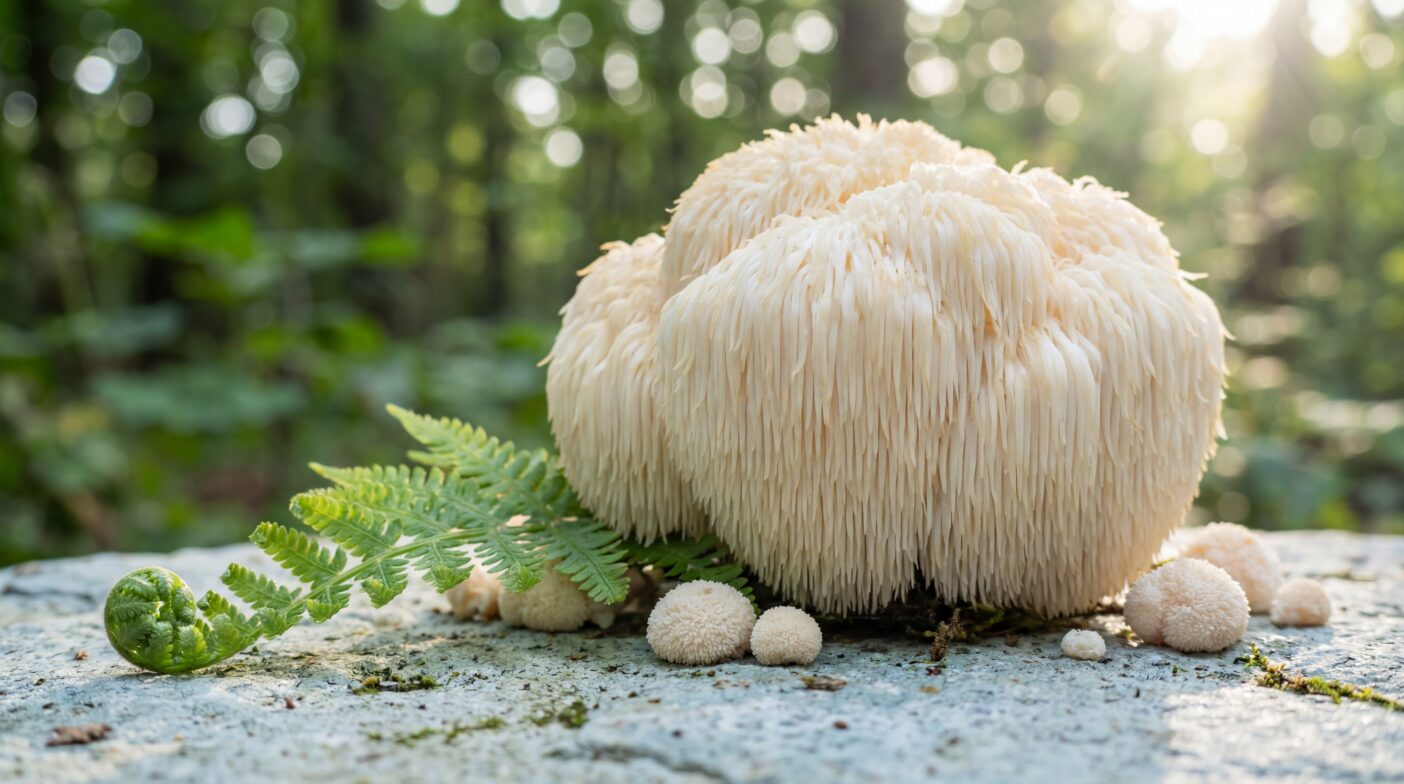
Lion’s Mane (Hericium erinaceus) belongs to the Hericiaceae family. Characteristic features include the long, drooping spines that give the fungus a distinctive appearance. The fruiting body grows on deciduous trees and is now predominantly cultivated under controlled conditions to ensure consistent quality and defined active ingredient profiles.
For cosmetic and functional applications, both fruiting body extracts and fermentatively derived mycelium extracts of lion’s mane mushroom are used.
Bioactive ingredients of lion’s mane mushroom
The effects of lion’s mane mushroom are characterized by a unique active ingredient profile that differs significantly from other medicinal mushrooms.
Erinacine is primarily present in the mycelium.
Hericenones are mainly found in the fruiting body.
Please note the following points regarding β-glucans and polysaccharides:
Please note that the substances mentioned are sterols and phenolic compounds.
Amino acids and trace elements do not exert their effects in isolation, but rather through complex biological signaling pathways.
Physiological Mechanisms of Action
In modern research, lion’s mane mushroom is being intensively studied in connection with nerve growth factor (NGF) regulation. This mechanism is of great importance with regard to the skin, as the skin, being a neuroimmunological organ, is closely linked to the nervous system.
Cosmetically relevant effects include:
Supporting the skin-nerve axis is of crucial importance.
It is crucial to reduce stress-related skin reactions.
It is crucial to improve barrier stability.
This product is suitable for soothing sensitive, reactive skin.
Eleutherococcus is ideal for modern neurocosmetic approaches, particularly to support epidermal regeneration.
Traditional use of Echinacea
Echinacea has been used in traditional Asian medicine for centuries.
Supporting the nervous system is of crucial importance.
- for the treatment of stress and exhaustion
- to harmonize digestion
- for general regeneration
This holistic perspective provides valuable insights for cosmetic concepts along the gut-skin-nerve axis, without making medical claims.
Hedgehog’s beard as an active ingredient in skincare
The use of hedgehog’s beard in cosmetic formulations is gaining increasing popularity, particularly in the premium and dermocosmetics segments.
The following section outlines the cosmetically relevant effects of hedgehog beard.
- This product has proven to soothe the skin in the treatment of neurogenic irritations.
- Supporting the skin barrier is an essential aspect of skincare.
- It is crucial to reduce stress-related redness.
- It promotes a balanced skin sensation.
- Support for skin regeneration
Hedgehog beard is particularly suitable for the following applications:
- Products for sensitive skin
- Anti-stress and calming products are ideal
- Barrier repair and night care
Physicochemical properties of the main active ingredients
The following section presents the physicochemical properties and skin effects of the key active ingredients derived from hedgehog beard.
1. Erinacine (primarily Erinacin A–I)
Chemical class: Diterpenoids
Molar mass: approx. 430–460 g/mol
Solubility: lipophilic, soluble in alcohols & oils
pH stability: stable in the pH 5–7 range
Effect on the skin:
Erinacines are the key neuroactive active ingredients of the lion’s mane mushroom. In cosmetic applications, they offer the following benefits:
- Improved communication between the skin and nerves.
- Reduction of neurogenic skin reactions.
- Regeneration of stressed skin
This product is ideal for use in neurocosmetics and anti-stress skincare.
2. Hericenones (A–H)
Chemical class: aromatic compounds
Molar mass: approx. 400–450 g/mol
Solubility: moderately lipophilic
Thermal stability: moderate
Effect on the skin: Hericenones exhibit the following effects:
The substance has an antioxidant effect.
The cell is protected by the treatment.
Hericenones complement Erinacine synergistically and help soothe the skin. This supports epidermal regeneration.
3. β-Glucans & Polysaccharides
Chemical class: Polysaccharides
Molar mass: 50–500 kD
Solubility: water-soluble
Sensory properties: slightly film-forming
Effect on the skin:
- Ability to bind moisture
- Strengthening of the skin barrier
- Reduction of irritation
The product line is particularly suitable for use with masks, serums, and barrier repair products containing hedgehog beard.
Product ideas with hedgehog beard
We present a selection of cosmetic product ideas that feature hedgehog beard as a central ingredient.
- The Neuro-Calm Serum contains hedgehog beard and panthenol.
- The ingredients of the “Barrier Repair Cream” include hedgehog beard and ceramides.
- The “Sensitive Skin Night Cream” contains hedgehog beard extract.
- The “Calming Mask” contains hedgehog beard and β-glucans.
- After-Stress Eye Cream with Hericium erinaceus and niacinamide
The concepts mentioned above can be excellently combined with Reishi, oat extract, madecassoside, or ceramide complexes.
Conclusion on Hericium erinaceus
Hedgehog moss is a highly innovative medicinal mushroom for modern skincare concepts targeting stress regulation, the skin barrier, and neurocosmetics. Its unique neuroactive ingredients make it a key active ingredient for the next generation of gentle, scientifically grounded skincare products.
At Cosmacon, we support you from the initial idea through formulation to market launch.
Through Tojo Cosmetics, we also produce private-label cosmetics starting with small quantities, while Cosactive supplies modern active ingredients and innovative raw materials starting at 1 kg.
References:
Mori et al., Phytotherapy Research
Friedman, Journal of Agricultural and Food Chemistry
Anti-Aging / Collagen: Aqueous Extracts of Pleurotus ostreatus and Hericium erinaceus Protect against Ultraviolet A-Induced Damage in Human Dermal Fibroblasts – Inhibition of MMP-1 (collagen degradation), promotion of type I procollagen. PubMed PMID 35446523 (2022)
Wound Healing / Regeneration: Hericium erinaceus β-glucan/tannic acid hydrogels for wound healing – Tissue regeneration, inhibition of TNF-α and IL-6, neovascularization in wound models. PubMed PMID 39244132 (2024)
Antioxidant / Radical Scavenger: >90% DPPH and superoxide radical inhibition in extracts. PubMed PMID 27347087 (2016)
Anti-Inflammation: Inhibition of NF-κB, MMP-9, and TNF-α-induced ROS production; activation of Nrf2 antioxidant genes. PMC4707368 (2016)
Direct cosmetic formulation study: Cleansing gels with Hericium erinaceus extract showed a reduction in TEWL, improved skin hydration, and no cytotoxicity in fibroblasts and keratinocytes. PMC9412612 (2022)
β-Glucan skincare – systematic review (2025): positive effects on wound healing, atopic dermatitis, photoaging, and UV damage. PMC12023766