
Selling on Amazon
Introduction
Amazon is the world’s largest marketplace. Most companies have considered selling on Amazon at some point, but not all of them have actually done so. There are many rumors surrounding the “mysterious” e-commerce giant. In this article, we would like to give you an insight into why it is worthwhile to use Amazon as a sales channel and how it works.
If, in the course of reading this article, you have realized that Amazon could be an interesting sales channel for your company, you can arrange a non-binding consultation with our partner Jung & Endter (contact details at the end of the article).
The 5 most important reasons why selling on Amazon is important
1) Extremely high traffic (user numbers): 44 million customers in Germany alone, 17 million of whom have Prime membership and order regularly, and 64,000 registered sellers. We are talking about Amazon Germany alone in 2016. However, visitor numbers have risen to up to 600 million per month in 2020. So it is extremely important to be on Amazon when selling.
From the customer’s point of view, the wide selection of different items from almost all areas plays an important role. From the buyer’s point of view, it is probably the extremely large reach right from the start. With your own online store, reach must first be achieved through hard work. As a seller on Amazon, you also have the opportunity to easily tap into other global markets.
2) Starting point for product searches: According to statistics (2016), approximately 34% of German online shoppers started their product research on Amazon. This means that they are specifically looking for a certain product with the intention of buying it. Instead of starting on Google, a third of Germans started on Amazon! This percentage is sure to rise in the future due to the constant expansion of offerings, the increase in user numbers, and the good promotion by Amazon itself.
If a potential customer starts their search directly on Amazon and finds what they are looking for there, they will not even notice your external online shop if you are not represented with your products on the marketplace. It is therefore clear that presence on Amazon is playing an increasingly important role.
3) High trustworthiness (conversion rate): Customers have a high level of trust in Amazon. Amazon as a marketplace or seller stands for speed, a large selection, and security. Customers appreciate this, and it is reflected in the sales figures and a conversion rate of approximately 10%. This means that, on average, one in ten visitors makes a purchase. Arguments in favor of this high conversion rate can also be found in the fourth point, “Simplicity for customers and sellers.”
4) Simplicity for customers and sellers: The selection is huge, the search is easy, and the prices are low. In addition, the ordering and payment process is simple and delivery of the ordered goods is usually very fast. Customers love it! They don’t have to worry about anything and trust the Amazon brand.
The Amazon sales channel is also relatively easy for sellers to tap into and manage. Even small businesses, manufacturers, and retailers can take advantage of the enormous potential it offers. With various services such as FBA (Fulfillment by Amazon), much of the work involved can be taken off your hands, allowing you to concentrate on your core business.
5) Easy to scale: With Amazon FBA, you can use Amazon’s logistics and don’t need your own fulfillment. This means you send your inventory to Amazon, where orders are sent to customers completely automatically! More on that later. Selling on Amazon is easy.
Selling on Amazon: Who is the buyer and who is the seller?
Amazon basically offers two completely different models for sellers: Vendor and Seller:
Normally, a new Amazon seller starts in the Seller Program. This means that you use Amazon as a marketplace to sell your products to end customers (similar to eBay). In other words, you are a seller. In this case, Amazon is your sales platform and brings you customers. As a seller, you can choose whether orders should be shipped from your own warehouse or whether you want to use Amazon’s incredibly well-developed and efficient logistics infrastructure (more on this later in the article). To start as a seller, you must create a seller account and list your products. How your products are offered is entirely up to you.
Only companies that are invited can participate in the vendor program. It is primarily aimed at well-known brands and manufacturers. As a vendor, companies sell their goods directly to Amazon. You are therefore a supplier to Amazon, and Amazon sells the products on its own. In this case, the online giant has complete control over prices, customer communication, logistics, product range, and advertising of your products. If you are invited to join the Vendor Program in the course of your e-commerce activities, it is important to weigh up the options carefully. In our experience, unpleasant scenarios can arise, such as lengthy contract and condition negotiations, non-transparent additional charges, or a sudden slump in sales figures.
Selling on Amazon: What is important?
This question is relatively easy to answer: To start as a seller, you need a valid business registration and a VAT registration in Germany (German VAT ID). Please note: Opening an account can be a stumbling block. Numerous documents are requested and checked for legitimation. You should allow sufficient time and patience for this step, but it is necessary because selling on Amazon should also be easy and secure for your customers.
In principle, anything that is permitted can be sold. If in doubt, this can be checked quickly and easily on Amazon’s help pages. It is important that you submit the usual evidence and approvals for some products before you start selling (e.g., for cosmetics: safety assessment, safety data sheet, marketability certificate).
However, you can only sell what is in demand! That’s why we often ask our customers: “Search for your product on Amazon – what do you find?” Amazon is a marketplace with a vast amount of collected data. With a few tools and experience (or with the right implementation partner), you can estimate the potential sales and thus weigh up the extent to which Amazon can be a profitable and attractive sales channel for your company.
Logistics solutions as an Amazon seller
Shipping yourself still seems to be the standard solution in online retail, even though large providers offer solutions that can save frustration and hassle – and at great prices. As an Amazon seller, you have two different shipping methods to choose from:
- FBA – Fulfillment by Amazon
- FBM – Fulfillment by Merchant
FBM means that the seller (Amazon merchant), i.e. you, takes care of the entire order process. This includes:
- Storage
- Shipping of goods
- Customer service
- Returns processing
The advantage from the merchant’s point of view is full control over the shipping and storage process. This means you can store and package your goods securely. If you store your goods with Amazon (FBA), you no longer have any direct influence over them. Transport damage or damage to goods in the warehouse may occur.
The disadvantage is the significantly higher cost. You need storage capacity and staff for picking and shipping the goods. You also have to upload tracking numbers yourself. Customer communication is significantly higher (e.g., package not arrived, returns processing, etc.). In addition, customers trust shipping by Amazon much more. With FBM, you do not have a “Prime” label on your products.
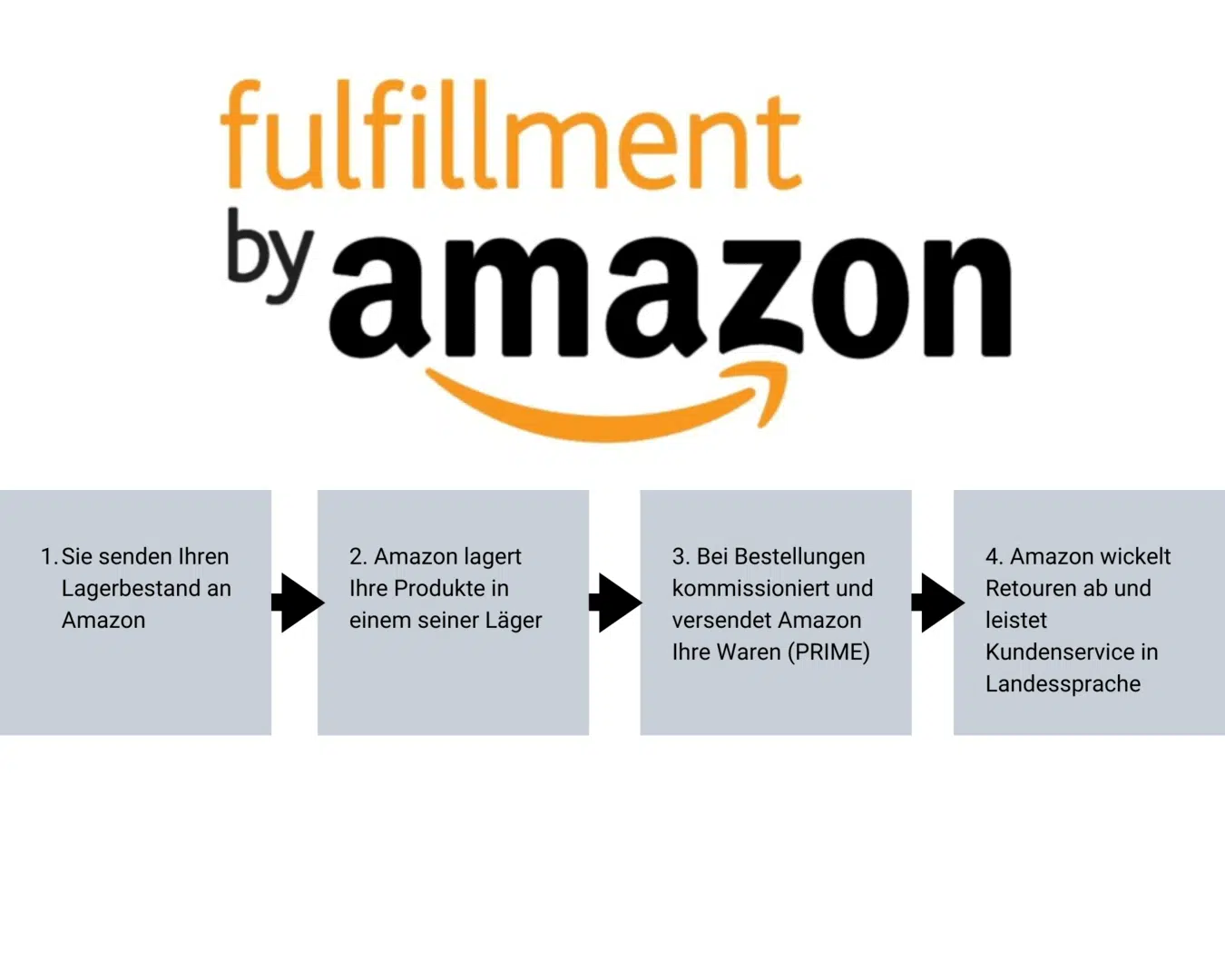
FBA: Processing by Amazon is significantly more advantageous than FBM. FBA, i.e., selling on Amazon including shipping by Amazon, means that you store your goods in an Amazon warehouse and Amazon takes care of the entire shipping process for you. You remain the owner of the goods; Amazon only takes care of the processes as a service provider for a fee (FBA fee).
As soon as your items are accepted and booked into the Amazon warehouse, your products are active and visible to buyers. They also carry the “Prime” label. If a customer orders one of your products, Amazon handles the entire shipping process for you. Your product is taken from the warehouse, packaged, and sent to the customer—at maximum speed. Amazon also automatically provides a tracking number for your customers. If the customer has any questions or concerns about shipping or wants to return the item, they contact Amazon customer service directly. With FBA, you transfer all essential tasks associated with receiving an order to Amazon for a fee.
Advantages of Amazon FBA:
- Prime logo and “Shipped by Amazon” logo: Free shipping for Prime customers. Generally higher customer confidence
- Improved ranking and higher chances in search results
- No need for your own warehouse: Your inventory is stored in one of Amazon’s numerous state-of-the-art warehouses. You remain the owner of the goods and can have them returned at any time for a fee.
- Fast shipping through Amazon: You no longer have to take care of shipping yourself, only monitoring and replenishing inventory
- Automatic shipment tracking for customers
- Outsourced, good customer service and returns processing.
- Europe-wide shipping: Expand at the touch of a button, so to speak. If you wish, your products can be activated for European marketplaces.
Disadvantages of FBA:
- No control: If you use Amazon as your logistics service provider, you no longer have any influence over the ordering and shipping processes.
Cost structure – How much does it cost me to sell on Amazon?
Many entrepreneurs ask how expensive the Amazon sales channel is for them and what fixed and variable costs are involved. At first glance, Amazon seems to be an “expensive” sales channel. However, when you consider the enormous potential and automation possibilities, this statement is put into perspective. Basically, selling on Amazon is rather inexpensive.
The reach and high purchase probability (conversion rate) on Amazon are particularly attractive. In addition, you can take advantage of the incredible logistics infrastructure. You don’t need your own logistics – so you save on this cost.
Fixed costs for Amazon seller account: A professional seller account costs EUR 39 per month, regardless of sales or the number of products.
Variable costs (usage-based payment model): When using FBA (Fulfillment by Amazon), you store your inventory in one of Amazon’s state-of-the-art logistics centers and remain the owner of the goods. Amazon handles storage, payment, shipping to the customer, and returns for you. Selling on Amazon saves you a significant amount of time and money.
This service incurs a comparatively low FBA fee, which is based on the dimensions and weight of your individual products. For example, a 500g package of flour costs only EUR 2.40 – and that’s only if the item is sold! Compared to the costs of shipping your own products (storage costs, picking, packaging, shipping costs), Amazon will probably be cheaper for you. We recommend comparing the two.
With Amazon, you are using the world’s largest marketplace with enormous reach. Amazon charges a percentage sales fee (depending on the category; approx. 15% of the retail price). This is not insignificant for many manufacturers and retailers. However, you should bear in mind that nowhere else will you get such reach and, above all, such a high conversion rate. Amazon is a buyer platform.
And, of course, selling through brick-and-mortar stores is not free either, and you also have to meet the conditions of Rossmann, dm, Edeka, Rewe, Douglas & Co.
Include estimated return rates, packaging costs, and shipping costs to Amazon (e.g., via DHL cardboard box or on pallets via freight forwarder) in your calculation.
In our experience, many companies lack the necessary know-how and staff capacity for Amazon. Many detailed questions arise that require days of research.
In order to make an informed business decision about whether Amazon is a profitable sales channel for your company and your products, it is essential to carry out a potential analysis in advance.
Brand building on Amazon
Manufacturers and private labels have far more opportunities to showcase their products on Amazon than “normal” retailers/resellers. Selling on Amazon also contributes to building your brand.
One of the essential success factors in e-commerce is the conversion rate (CR). The CR is the probability of purchase. Therefore, the higher the CR, the more purchases are made with consistently high traffic. To make it easier for buyers to make a purchase decision and increase the CR, Amazon offers the option of creating additional individual brand content.
What is brand content and what are its advantages?
You are probably familiar with this: traditionally, a product listing on Amazon consists of a title, 5 bullet points, and a product description text.
With brand content (A+ Content), you can replace the traditional product description and use a customizable, larger, and better advertising space for your product. Ultimately, you increase your CR (and thus your sales) through compelling, optimally presented information and an attractive brand experience.
- More display options to highlight features and benefits
- Customer identification with the brand – corporate identity
- High-quality images, graphics, typography, and elements
- Cross-selling with comparison tables
- Search engine optimization due to content indexing by Google
- Stand out from competitors and attract more attention
In addition to A+ content on the product page, as a brand owner you get additional, more prominent advertising opportunities. In addition to classic sponsored ads, you have the following options:
Brand Store: You have the option of creating your own store on Amazon for your brand. Based on the shop-in-shop principle, you can showcase your best products, engage in cross-selling, present your company, and much more. Customers can access this store via your brand name or headline search ads. Once in the store, customers will not see any competing offers—only your product range will be visible.
Headline search ads: These are particularly attractive advertising banners for specific keywords that appear at the top of the search results. Customers can then access the brand store.
Video ads: Video ads in search results are a completely new option. They allow you to present a product quickly and easily and generate more traffic to your product page.
The most important requirement for using brand content, the Brand Store, and the new ad options is an officially registered trademark (e.g., with the DPMA). You or your company must be the owner of this trademark. Registration takes place at Amazon Brand Registry.
Is Amazon worthwhile for my products?
Amazon offers truly unique opportunities to grow in e-commerce.
You can get a rough overview of “competitive products” by doing your own research. Can you find your own or comparable products on Amazon? If so, that’s a good sign and selling on Amazon will certainly be worthwhile.
However, there are also products that are difficult to sell on Amazon. Large and heavy products, for example, but also items that no one buys on Amazon or that are not typically purchased online. No one would buy a car on Amazon, for example. However, our customers report very positively on Amazon as an important sales channel for Kometika. In addition to your own online shop, selling on Amazon also contributes to your own brand. High-quality cosmetics have become an important factor in individualization and are often “migeshopped.”
Whether selling your products on Amazon is worthwhile depends on many factors that are relatively difficult to assess from the “outside.” Even if a product is well suited for the Amazon FBA program, that doesn’t mean it will be a success. What matters then is how strong the competition and demand are.
Which “keywords” (the search terms that can be entered on Amazon) can you rank with your products? What prices should you charge? How much margin remains after Amazon and FBA fees? What do you need to budget for advertising and when?
Of course, there are many questions that come up at the beginning of such a project. However, these should definitely be clarified before wasting time and money – only to end up with losses on Amazon. There are agencies that want to sell you expensive consulting services without highlighting the actual potential of your products.
It’s not enough to create an Amazon account and “upload” the products. Ensuring that the products a) rank under the right keywords and b) generate profits instead of headaches is a real art…
That’s why we recommend our partners Maximillian Endter and Christian Jung, who will be happy to carry out a potential analysis developed specifically for you.
This analysis will provide you with a sound concept for your products on Amazon. This concept contains the following valuable information:
- how much revenue you can generate in your niche
- how much revenue your competitors are making and their weaknesses
- what prices or product sets you should offer
- a product calculation and an overall calculation for the year (all fees)
- how much budget (including advertising budget) you should plan for a successful launch on Amazon
In short: a complete small-scale “market research” for your products. In addition, there is an action plan that shows how this potential can be achieved step by step.
If this sounds exciting to you and you need help with your Amazon sales, please feel free to request a consultation appointment.
Cosmacon is happy to support you with additional new cosmetics for your brand and our partners in implementing sales on Amazon.
Maximilian Endter
Managing Director
Jung & Endter Online Marketing UG (limited liability)
Obere Mühlgasse 10
98587 Steinbach-Hallenberg
Tel: +49 170 7177343
Email: mail@jung-und-endter.de
Internet: https://jung-und-endter.de