Microbiome 2.0: New Active Ingredients for a Balanced Skin Microbiome
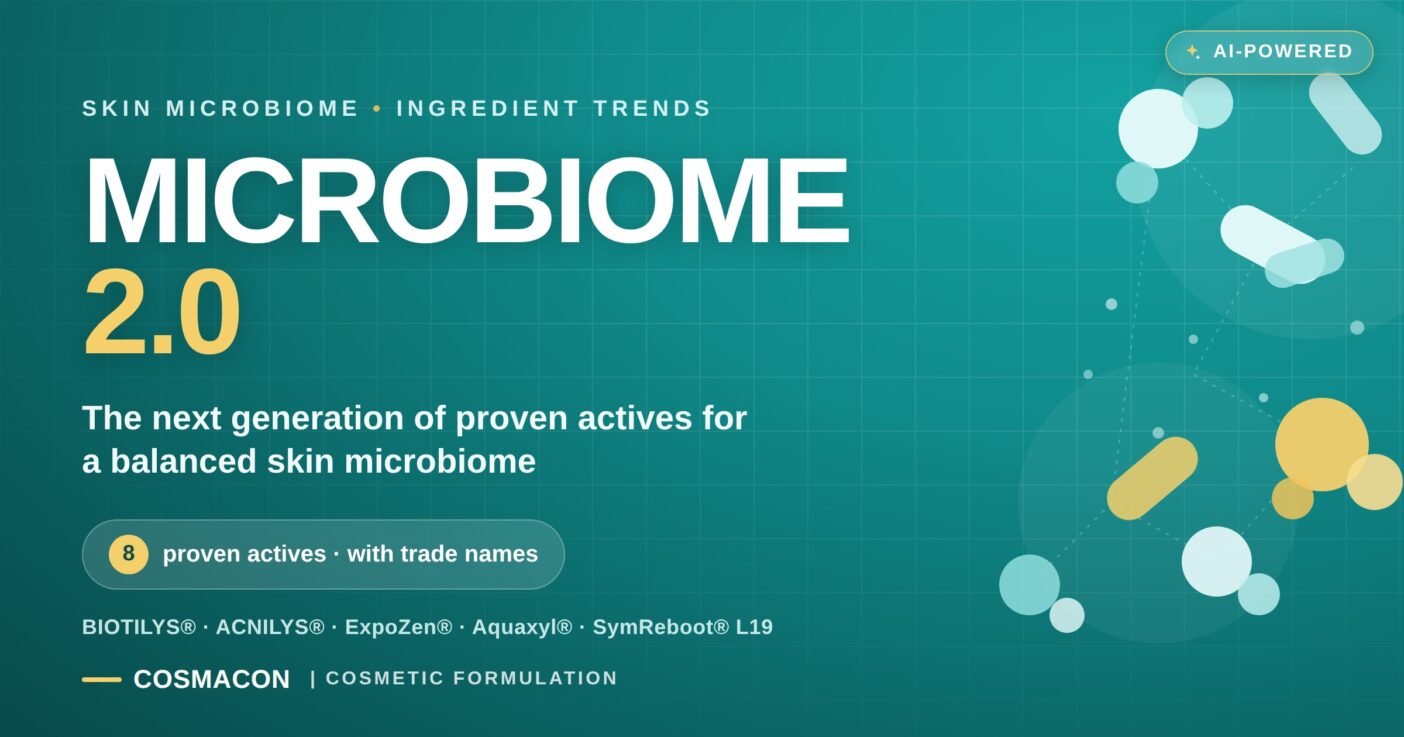
For decades, the rule in cosmetics was: as germ-free as possible, cleansed as thoroughly as possible. This way of thinking is outdated. Under the banner of Microbiome 2.0, a paradigm shift has taken place—away from mere germ reduction and toward the targeted modulation of the microbial community on the skin and scalp. This article introduces eight new, clinically tested active ingredients along with their trade names and categorizes them according to the most important skin concerns.
What Microbiome 2.0 Means
The skin is a highly specialized ecosystem that harbors a dynamic interplay of bacteria, fungi, and viruses. This microbiota regulates barrier function, immune homeostasis, and protection against pathogenic colonization. When this balance is disrupted—a condition known as dysbiosis—the consequences manifest as acne, sensitive skin, dandruff, or hair loss.
The first wave of microbiome cosmetics focused primarily on live probiotics. Microbiome 2.0 takes a decisive step further: Instead of non-specifically reducing microbes or adding live cultures, the new actives utilize biotechnologically and naturally derived postbiotics, ferment lysates, and selective pre-substrates. They specifically modulate individual microbial taxa—promoting beneficial commensals and suppressing problematic strains without destroying diversity. It is precisely this selectivity that lies at the heart of Microbiome 2.0.
In short: Microbiome 2.0 marks the transition from “killing germs” to “targetedly balancing the ecosystem.” Compared to live probiotics, postbiotics offer better formulation stability, safety, and shelf life—while delivering comparable biological efficacy.
For brands and developers, this is more than just a trend. The market for microbiome-adapted skincare was valued at approximately $438 million in 2024 and is projected to grow to about $1.4 billion by 2034. Those who invest in Microbiome 2.0 today are positioning themselves in a category that is transitioning from a niche market to everyday basic skincare.
An Overview of Skin Concerns
The new generation of active ingredients is best understood in the context of specific skin concerns. Each concern is linked to a typical dysbiosis—and for each, there is a validated active ingredient within Microbiome 2.0:
- Barrier & Sensitivity – Imbalance between Staphylococcus aureus (barrier-disrupting) and Staphylococcus epidermidis (protective).
- B Blemished, acne-prone skinB – Overabundance of virulent Cutibacterium acnes phylotypes and pro-inflammatory lipid mediators.
- B Sensitive, reactive skin & rednessB – Increased Corynebacterium density, exacerbated by exposome factors such as UV, environmental pollution, and stress.
- Dandruff & itchy scalp – combined fungal-bacterial dysbiosis involving Malassezia.
- Hair loss & thinning hair – altered ratios between Cutibacterium, Staphylococcus, and Malassezia in androgenetic alopecia.
- Dryness & weakened moisture barrier – lack of moisture promotes the growth of undesirable strains.
- Body odor – odor-producing bacteria in the underarm region.
8 Product Recommendations with Brand Names and Active Ingredients
The following eight active ingredients form a comprehensive Microbiome 2.0 modular system—ranging from facial care to sensitive skin, scalp, hair, and deodorant. All are backed by clinical or microbiological data.
Concerns: Barrier & Sensitivity
1. BIOTILYS® – the postbiotic for barrier & immunity
Active ingredient (INCI): Lactobacillus Ferment Lysate · Supplier: Greentech
A postbiotic ferment lysate that actively restores the balance between S. aureus and S. epidermidis. It strengthens β-defensins and psoriasin, suppresses TLR-2 inflammatory signaling, and reinforces the cohesion of the stratum corneum. Even under microbial stress, the tight junction proteins claudin-1 and desmoglein-1 are preserved—the skin feels noticeably soothed, and transepidermal water loss decreases. Ideal barrier-immunity modulator for repair creams, recovery serums, and post-procedure balms.
Concern: Blemished, acne-prone skin
2. ACNILYS® – Sebum & Inflammation Mediator Modulator
Active ingredient (INCI): Rhodomyrtus Tomentosa Fruit Extract · Supplier: Greentech
A polyphenol-rich plant extract from the berries of Rhodomyrtus tomentosa that specifically rebalances the acne ecosystem: It increases microbial diversity, reduces pro-inflammatory C. acnes phylotypes (IA1), promotes the protective phylotype II, and regulates sebum production. What sets it apart is its underlying mechanism—by acting on the lipid mediators of inflammation resolution (SPMs/resolvins/lipoxins), it addresses the biochemical root cause of acne rather than just the symptoms. For anti-blemish serums, mattifying skincare, and cleansing systems.
Concerns: Sensitive, reactive skin & redness
3. ExpoZen® – Exposome, Neuroinflammation, & Barrier Protection
Active ingredient (INCI): Hydrolyzed Rhodophyceae Extract (Halymenia durvillei) · Supplier: Greentech
Sulfated polysaccharides from the red seaweed Halymenia durvillei counteract the cascade of sensitive skin reactions on multiple levels: They inhibit pro-inflammatory cytokines (IL-6, TNF-α), modulate the neuroinflammatory signaling associated with discomfort, protect against exposome-induced mTOR activation, and preserve microbial diversity. Microbiologically, there is an increase in Chryseobacterium accompanied by a decrease in Corynebacterium—a signature pattern of well-tolerated skin. For soothing care, anti-redness formulations, and urban/anti-pollution lines.
Concern: Dandruff & itchy scalp
4. DANDRILYS® – eco-friendly anti-dandruff solution
Active ingredient (INCI): Ziziphus joazeiro bark extract · Supplier: Greentech
Dandruff today is not purely a fungal issue, but rather a combined fungal-bacterial dysbiosis. The saponin-rich active ingredient derived from the bark of Ziziphus joazeiro restores the disrupted scalp ecosystem rather than suppressing it: It modulates both Malassezia and the bacterial flora, reduces histamine-driven itching, and regulates sebum production. The result: less dandruff, a calmer scalp, and long-lasting sebum reduction without a rebound effect—unlike zinc pyrithione. For microbiome shampoos, scalp serums, and sensitive scalp care.
Concerns: Hair loss & thinning hair
5. HAIRILINE® – Scalp Environment for Thicker Hair
Active ingredient (INCI): Lindera Strychnifolia Root Extract · Supplier: Greentech
Premature hair loss and androgenetic alopecia are increasingly linked to a microbial imbalance of the scalp. The root extract from Lindera strychnifolia simultaneously modulates the scalp microbiota and the signaling pathways of the dermal papilla: It lowers the C. acnes/S. epidermidis ratio by approximately 37.8%, reduces DHT-induced Wnt antagonists (DKK-1, sFRP-1, TGF-β1), and thereby prolongs the anagen phase. Clinically, this results in reduced hair loss and progressively increasing hair density. Ideal for leave-on scalp tonics and “hair density” lines.
Concerns: Dryness & weakened moisture barrier
6. Aquaxyl® – the prebiotic-acting moisturizing polyol
Active ingredient (INCI): Xylitylglucoside – Anhydroxylitol – Xylitol · Supplier: Seppic
A patented polyol complex that combines hydration with microbiome care. At 1.5%, it acts as a selective prebiotic substrate and promotes beneficial commensals such as S. epidermidis and Corynebacterium xerosis without favoring opportunistic bacteria. With or even more as 3%, it inhibits S. aureus biofilm formation on reconstructed epidermis. At the same time, it increases aquaporin-3 expression, strengthens tight junctions, and boosts ceramide synthesis. Moisture and the microbiome are thus treated not as separate goals, but as two dimensions of the same skin homeostasis.
Concerns: Sensitive Skin & Scalp / Soothing
7. SymReboot® L19 – the paraprobiotic “Truebiotic”
Active ingredient: heat-treated Lactiplantibacillus plantarum (Heal19) · Supplier: Symrise
A COSMOS-compliant, paraprobiotic solution based on heat-treated Lactiplantibacillus plantarum “Heal19.” As a postbiotic, it combines safety and formulation stability with genuine biological efficacy: It helps skin cells recognize microbial components and activates the body’s own defense mechanisms. This strengthens the skin barrier’s integrity, soothes visible irritation, and supports the microbiome balance on the skin and scalp. For sensitive-care serums, scalp tonics, and soothing moisturizers.
Concern: Body Odor / Deodorant
8. SymDeo® B125 – Microbiome-Friendly Deodorant Active Ingredient
Active Ingredient: Microbiome-Friendly Deodorant Active Ingredient · Supplier: Symrise
Traditional deodorant technologies reduce the overall microbial load broadly and nonspecifically. SymDeo® B125 follows the precision approach of Microbiome 2.0: The active ingredient specifically inhibits odor-causing microorganisms without disrupting the broader underarm microbiome. In vivo studies show odor reduction for up to 72 hours—and the active ingredient is readily biodegradable. For microbiome-friendly deodorants and anti-odor concepts that meet clean beauty standards.
Active Ingredient Matrix: Microbiome 2.0 at a Glance
| Trade Name | Active Ingredient / INCI | Skin Concern | Target Taxa |
|---|---|---|---|
| BIOTILYS® | Lactobacillus Ferment Lysate | Barrier & Sensitivity | S. aureus ↓ / S. epidermidis ↑ |
| ACNILYS® | Rhodomyrtus Tomentosa Fruit Extract | Acne, Blemished Skin | C. acnes IA1 ↓ / Phylogenetic Type II ↑ |
| ExpoZen® | Hydrolyzed Rhodophyceae Extract | Sensitive skin, redness | Corynebacterium ↓ / Chryseobacterium ↑ |
| DANDRILYS® | Ziziphus joazeiro bark extract | Dandruff, itchy scalp | Malassezia + bacteria |
| HAIRILINE® | Lindera strychnifolia root extract | Hair loss, hair density | C. acnes/S. epidermidis ratio |
| Aquaxyl® | Xylitylglucoside – Anhydroxylitol – Xylitol | Dryness, barrier | Commensals ↑ / S. aureus biofilm ↓ |
| SymReboot® L19 | Lactiplantibacillus plantarum | Sensitive skin & scalp | Barrier & Defense |
| SymDeo® B125 | 2-Methyl-5-cyclohexylpentanol | Body Odor | Odor-causing bacteria |
This matrix illustrates why Microbiome 2.0 is not about a single active ingredient, but rather a portfolio approach: Each concern is addressed with a precisely matched, tested active ingredient—and can be combined into complete skincare lines.
FAQs on Microbiome 2.0
What is Microbiome 2.0?
Microbiome 2.0 refers to the new generation of microbiome cosmetics. Instead of non-specifically reducing bacteria or adding live probiotics, tested postbiotics, ferment lysates, and prebiotic substrates specifically modulate individual microbial taxa—they promote beneficial commensals and suppress problematic strains without destroying microbial diversity.
How does Microbiome 2.0 differ from traditional probiotic skincare?
The first wave relied on live bacteria, which pose stability, preservation, and shelf-life challenges in cosmetics. Microbiome 2.0 primarily uses postbiotics—non-living microbial cells or their components. They are formulation-stable, safe, and yet interact with the skin in a biologically meaningful way.
What skin concerns can be addressed with Microbiome 2.0 active ingredients?
Barrier dysfunction and sensitive skin, blemished or acne-prone skin, sensitive/reactive skin with redness, dandruff and an itchy scalp, hair loss, dryness, and body odor. For each of these concerns, there is a tested active ingredient within Microbiome 2.0.
Are postbiotics better than live probiotics in cosmetics?
For most cosmetic applications, yes. Postbiotics offer better formulation stability and safety with comparable biological efficacy—which is why they are considered the practical future of microbiome care and form the backbone of Microbiome 2.0.
What trade names are suitable for a Microbiome 2.0 formulation?
Proven, tested options include BIOTILYS®, ACNILYS®, ExpoZen®, DANDRILYS®, and HAIRILINE® (Greentech), Aquaxyl® (Seppic), as well as SymReboot® L19 and SymDeo® B125 (Symrise). Which active ingredient is best depends on the target concern, the product concept, and the desired positioning.
Is Microbiome 2.0 also relevant for the scalp and hair?
Yes—“Scalp is the new skin.” Scalp dysbiosis is associated with dandruff and hair loss. DANDRILYS®, HAIRILINE®, and SymReboot® L19 are specifically designed to promote a balanced scalp microbiome.
How are Microbiome 2.0 products marketed in compliance with EU regulations?
Claims such as “microbiome-friendly” or “supports the skin barrier” must be substantiated under the EU Cosmetics Regulation (Regulation 1223/2009) and free of medicinal claims. The clinical and microbiological data on the active ingredients form the basis of substantiation; the specific wording of claims should be reviewed prior to market launch.
How do I develop my own Microbiome 2.0 product?
The fastest way is through an independent formulation partner: Cosmacon develops custom formulations based on Microbiome 2.0, while Tojo Cosmetics offers ready-made white-label solutions for rapid market entry. See below for details.
Your Microbiome 2.0 Product – with Cosmacon & Tojo Cosmetics
Would you like to turn the active ingredients presented here into a market-ready product? As an independent development group—with no ties to corporate groups or suppliers—we’ll guide you from the initial idea to a compliant formulation.
Cosmacon develops your custom Microbiome 2.0 formulation, tailored to your needs, including compliance with EU regulations (CPSR/PIF/CPNP) and a robust basis for claims. Tojo Cosmetics gets you to market quickly with tested white-label concepts—ready for your brand—under your logo, your brand, and your packaging.
Have a formulation developed →
Discover white-label options →
Note on preliminary review: Trade names, INCI names, active ingredient data, and the links provided were researched to the best of our knowledge but should be cross-checked against the latest manufacturer data sheets and the applicable EU Cosmetics Regulation prior to publication. All claims regarding efficacy are to be understood in a cosmetic context; medical or therapeutic claims are excluded.
Sources
Active Ingredients & Trade Names:
- BIOTILYS® (Greentech) – greentech.fr/biotilys
- ACNILYS® (Greentech) – greentech.fr/acnilys
- ExpoZen® (Greentech) – greentech.fr/expozen
- DANDRILYS® (Greentech) – greentech.fr/dandrilys
- HAIRILINE® (Greentech) – in-cosmetics.com/hairiline
- Aquaxyl® (Seppic) – seppic.com/aquaxyl
- SymReboot® L19 (Symrise/Probi) – symrise.com/symreboot-l19
- SymDeo® B125 (Symrise) – symrise.com/symdeo-b125
Peer-reviewed studies:
- Rhodomyrtus tomentosa & C. acnes phylotypes in acne – Cosmetics 2020, 7(3), 53. mdpi.com/2079-9284/7/3/53
- Halymenia durvillei & sensitive/reactive skin – Cosmetics 2019, 6(4), 69. mdpi.com/2079-9284/6/4/69
- Lindera strychnifolia & the scalp microbiome in androgenetic alopecia – Int. J. Cosmet. Sci. 2020. Wiley / IJCS · PubMed 32803888
- Market data on microbiome skincare – Polaris Market Research (2024); Mintel/Euromonitor (2024).
- COSSMA 7–8/2026, “Close Up” Special Feature on the Microbiome (pp. 29–39): Articles by Petra Schlegel (Greentech), Claire Liu (Seppic), and Christina Vegge (Symrise/Probi). – www.cossma.com