
Hyaluronic Acid as a Barrier Protection
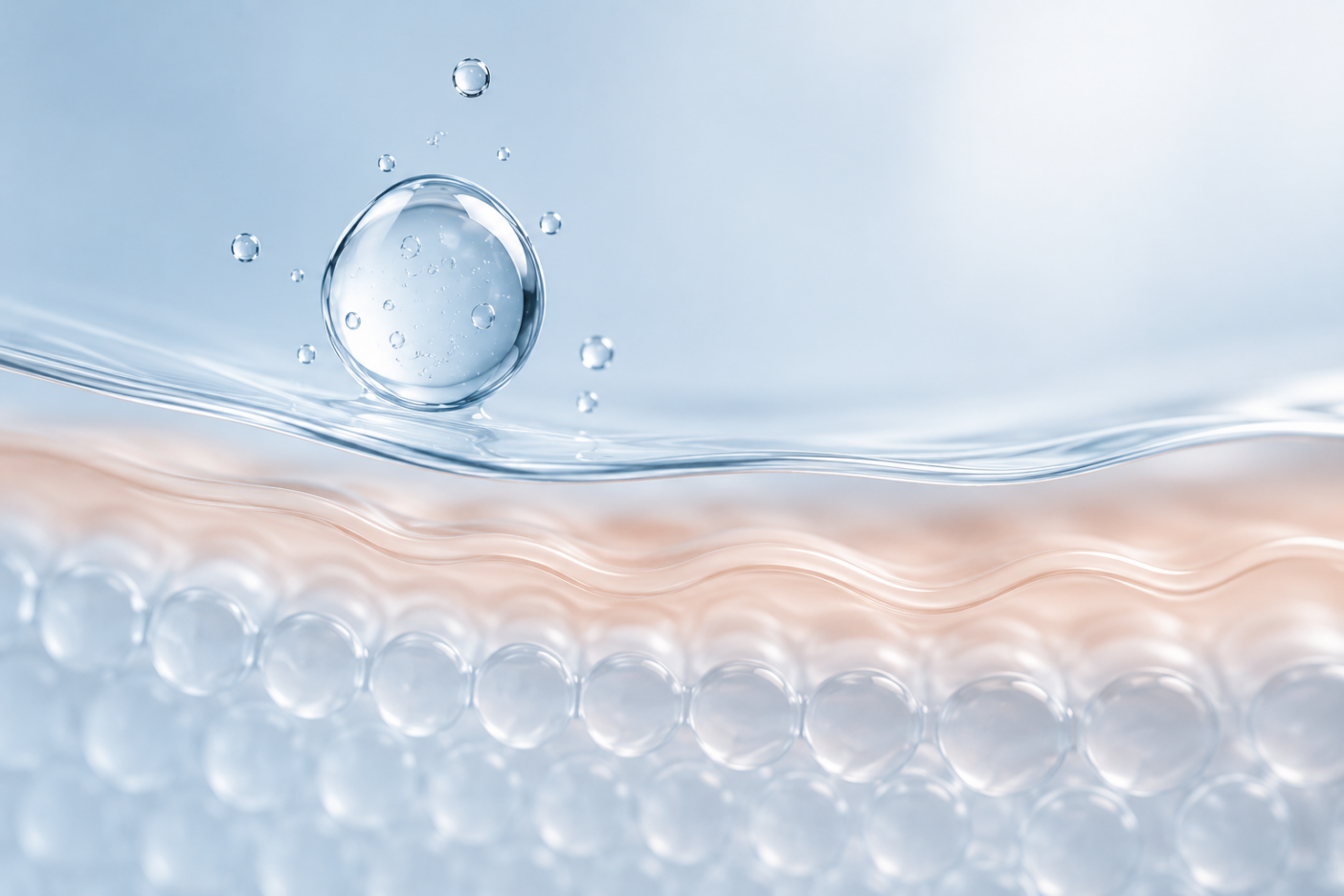
Hyaluronic acid is found throughout the body wherever large amounts of water need to be bound—especially in the intercellular spaces of the skin. It hydrates the skin, supports its elasticity, and contributes to a smooth, plump complexion. At the same time, these moisture reserves strengthen the skin’s natural barrier and increase its resistance to external influences.
Hyaluronic Acid as a Barrier Protection from the Very Beginning
Hyaluronic acid is present in humans from the very earliest stages of development. It is present in the embryonic mesenchyme and plays an important role in fertilization as well as in the implantation of the blastocyst into the uterine lining.
During embryonic development, it forms an essential component of the extracellular matrix and surrounds nearly all body cells. In doing so, it protects and separates the cells from one another, while at the same time enabling their communication and cohesion.
These functions demonstrate the importance of hyaluronic acid as a protective barrier from an early stage. It performs mechanical, immunological, and regulatory functions and plays a key role in UV protection and tissue repair.
How Hyaluronic Acid Protects the Skin Barrier
In the skin, hyaluronic acid forms an important water reservoir. The electrolytes dissolved in it help stabilize the electrolyte balance. Thanks to its high water-binding capacity and degree of swelling, hyaluronic acid regulates the transport of ions, proteins, and cells within the tissue.
Due to its high viscosity, it also acts as a natural diffusion barrier. It hinders the penetration of pathogens and can limit the spread of local infections. At the same time, the hyaluronic acid-containing matrix influences the availability of various cytokines and other biologically active molecules.
A dense and well-hydrated matrix can also reduce the susceptibility of cells to external stressors.
Support for Regeneration and the Immune System
Hyaluronic acid plays a central role in repairing the skin barrier. It supports the proliferation of fibroblasts and facilitates the migration of immunocompetent cells into damaged tissue.
Low-molecular-weight hyaluronic acid fragments, in particular, can activate dendritic cells and thus support the skin’s immune defense. At the same time, they protect granulation tissue from oxidative stress and free radicals during wound healing.
Effect on the Epidermis
Hyaluronic acid is particularly important for the development of keratinocytes and thus for the continuous renewal of the epidermis.
It influences the formation of the lipid matrix of the stratum corneum and contributes to the stability of the so-called cornified envelope. In this way, it directly supports the functionality of the outer skin barrier.
Hyaluronic Acid as a Free Radical Scavenger
In addition to its moisture-binding properties, hyaluronic acid also acts as a natural free radical scavenger. It can neutralize reactive oxygen species (ROS), which are generated in particular by UV radiation.
In this way, it helps protect cellular structures and counteract premature skin aging. This antioxidant effect makes hyaluronic acid a valuable active ingredient in modern anti-aging and sunscreen formulations.
The Problem of Molecular Size
Despite its numerous benefits, high-molecular-weight hyaluronic acid has one limitation: due to its large molecular weight, it can only penetrate the skin to a limited extent.
It remains primarily on the skin’s surface, where it forms a moisturizing film. This film ensures a smoother complexion and reduces transepidermal water loss.
However, high-molecular-weight hyaluronic acid has only limited ability to directly affect deeper layers of the skin.
Hyaluronic Acid as a Barrier Protector in Practical Testing
The efficacy of hyaluronic acid and its fragments has been evaluated in various studies.
Both healthy skin and skin previously damaged by sodium lauryl sulfate were treated. The results showed excellent skin tolerance. Neither irritation nor contact allergies nor significant skin redness were observed.
To evaluate the barrier effect, the hydration of the stratum corneum was measured using corneometry, as well as transepidermal water loss (TEWL).
The studies confirmed that low-molecular-weight hyaluronic acid fragments, in particular, can increase skin moisture and support the regeneration of the skin barrier.
Combination of Different Molecular Weights
The best results are often achieved by combining different types of hyaluronic acid.
- High-molecular-weight hyaluronic acid with a molecular weight of more than 1,000 kDa forms a protective moisture film on the skin’s surface and reduces water loss.
- Low-molecular-weight fragments of approximately 50 kDa or less, on the other hand, can penetrate deeper into the epidermis and contribute to long-term moisture supply there.
Combining different molecular weights allows for optimal hydration of both the superficial and deeper layers of the skin.
Hyaluronic Acid Blend for a Strong Skin Barrier
Formulations with a broad molecular weight spectrum—ideally including fractions in the range of about 10 kDa—are now considered particularly effective.
They can:
- strengthen the skin barrier,
- increase skin hydration,
- smooth the skin’s surface,
- reduce redness and flaking,
- reduce oxidative stress,
- nourish mature skin, and
- support anti-aging effects.
It is important to use highly pure, biotechnologically produced hyaluronic acid to ensure maximum safety and efficacy.
Conclusion
Hyaluronic acid, when used as a barrier protector, does far more than simply provide moisturization. It stabilizes the skin barrier, supports regeneration, protects against oxidative stress, and sustainably improves skin hydration.
Modern formulations that combine different molecular weights are particularly effective, as they reach both the skin’s surface and deeper layers of the epidermis.
Cosmacon utilizes the full spectrum of high-quality hyaluronic acids and is happy to advise you on the development of innovative skincare products designed to strengthen the skin barrier.
If you need a quick solution:
✨ Our partner Tojo Cosmetics offers innovative, active-ingredient-rich private-label products—quickly available, high-quality, and perfect for brands that want to impress with passion and quality.