
Glycerine in cosmetics: effects, studies, skin physiology
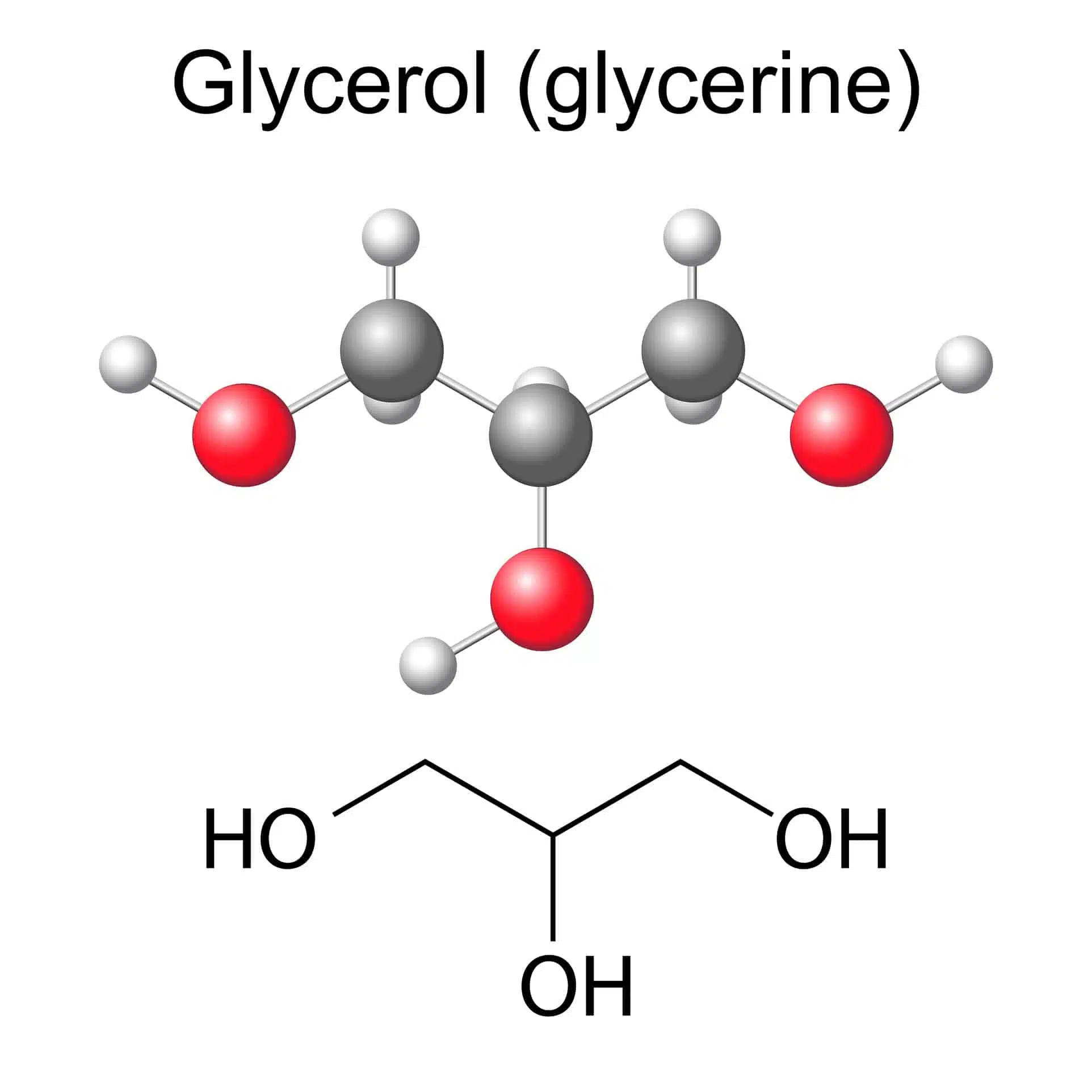
What is glycerol?
Glycerol, or glycerin or glycerine (INCI: Glycerin) is a trihydric alcohol (propane-1,2,3-triol) with the molecular formula C₃H₈O₃. It is one of the most thoroughly researched and most frequently used humectants in cosmetics.
Physicochemical data:
– INCI: Glycerin
– Chemical name: Propane-1,2,3-triol
– CAS: 56-81-5
– Molar mass: 92.09 g/mol
– Appearance: clear, viscous liquid
– Completely water-soluble
– Hygroscopic (strongly water-binding)
– Boiling point: approx. 290 °C
The three hydroxyl groups enable pronounced water binding and explain its high efficiency as a moisturizer.
Where does glycerine occur naturally in the body?
Glycerine is a physiological component of the human organism and occurs, among other things, as a building block of triglycerides (adipose tissue), as a component of phospholipids (cell membranes), and as a component of the Natural Moisturizing Factor (NMF). It is transported via aquaporin-3 channels in the epidermis and is an intermediate product in energy metabolism. In the skin, glycerine supports hydration, elasticity, and barrier function.
How does glycerine work in the skin?
The effect is multifactorial:
- Moisture retention: Binds water in the stratum corneum and measurably increases skin moisture.
- Barrier strengthening: Studies show improved lipid organization and faster barrier regeneration.
- Reduction of TEWL: Reduces transepidermal water loss.
- Improvement of skin elasticity: Increases the mechanical flexibility of the stratum corneum.
Clinical studies (selection):
– Lodén (2003): Significant improvement in skin moisture through topical glycerine.
Fluhr et al. (2008): Accelerated barrier regeneration after irritation.
Rawlings & Harding (2004): Positive effect on stratum corneum hydration and skin mechanics.
Verdier-Sévrain and Bonté (2007): Glycerine is the gold standard among moisturizers.
The evidence is exceptionally solid—hardly any other moisturizing product is better documented.
Industrial production is carried out on a large scale—sustainably and vegan
- Biodiesel production (upcycling): The transesterification of vegetable oils produces crude glycerine as a by-product, which is purified to achieve cosmetic quality.
- Fat recycling: Recovery from vegetable fat streams.
- Vegetable hydrolysis: Splitting of triglycerides from vegetable oils.
This means that the raw material is vegan, sustainably available, a by-product of energy production, and relevant to the circular economy—a prime example of functional upcycling in the cosmetics industry.
Why glycerine is indispensable despite its “boring” nature:
It fulfills several functions in almost every emulsion:
– Base hydrator
– Penetration enhancer
– Sensory modulator
– Stability improver
– Effect enhancer in combination with amino acids, urea, ceramides
Without this substance, many high-end formulations simply do not work.
New products with glycerol for your brand
For a quick market entry, Tojo Cosmetics offers immediately available, EU-compliant white label products in which this active ingredient is already formulated.
For individual production orders, Cosactive offers formulation-tested active ingredient mixtures starting from small quantities.
At our partner company Cosmacon, we are happy to assist you with individual product developments using this innovative active ingredient.