
Dexpanthenol
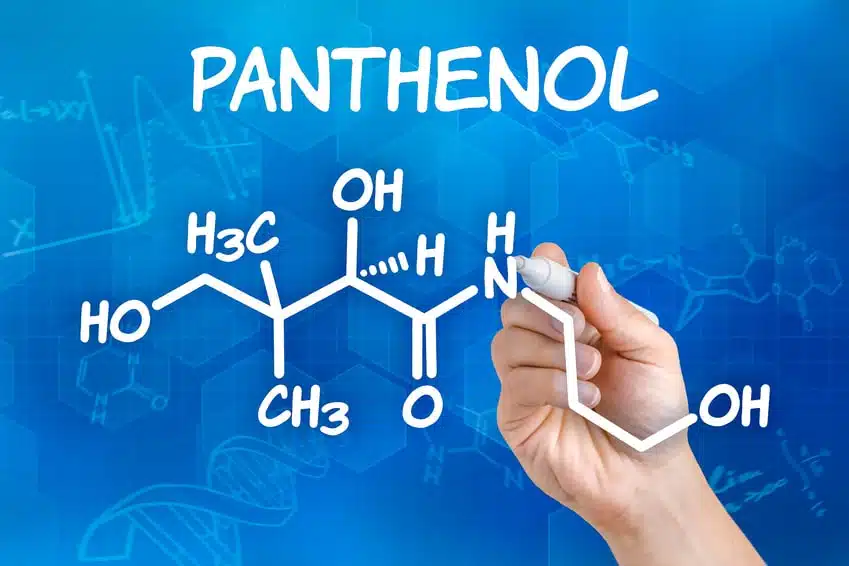
What is Dexpanthenol?
Dexpanthenol is also known as D-panthenol, provitamin B5, and panthenol. The chemical compound is converted in our body into pantothenic acid, which in turn is an important component of coenzyme A and plays an essential role in carbohydrate, fat, skin, and amino acid metabolism. All mucous membranes, connective tissue, and even our nails and hair need pantothenic acid for optimal development. It is also very important for the body’s immune system.
Pantothenic acid in nutrition
As an essential nutrient, pantothenic acid, first discovered in 1931, is found in many foods, especially nuts, eggs, offal, whole grain products, brewer’s yeast, milk, and avocados. Adults need about six milligrams per day. Although a deficiency in pantothenic acid is rare in a balanced diet, it can have fatal consequences if it does occur, as it can lead to severe sensory disturbances (paresthesia), “burning feet syndrome” (pain in the toes and soles of the feet), brittle hair, and dry, brittle skin.
Dexpanthenol as an active cosmetic ingredient
Dexpanthenol, the precursor of the extremely important pantothenic acid, is an active ingredient used in many medicines and cosmetic products. It relieves itching, has an anti-inflammatory effect, promotes the formation of new skin cells, moisturizes, and supports the regeneration of wounded skin. Due to these many benefits, dexpanthenol is also colloquially known as the “skin vitamin.”
Dexpanthenol for skin and hair
Wound healing & skin regeneration
Panthenol is particularly often used for the external treatment of injuries, minor wounds, and skin inflammation. The substance is also suitable for treating the mucous membranes in the mouth and nose. It is a common ingredient in nasal sprays and helps to moisturize the nasal mucous membranes. Cracked, dry skin on various parts of the body becomes more elastic again and receives sufficient moisture. A concentration of just 1.0 percent is sufficient to significantly improve the skin’s barrier function.
Sunburn & irritation relief
Dexpanthenol soothes the skin in cases of sunburn, thereby alleviating unpleasant burning and pain.
Hair care benefits
Shampoos containing panthenol are particularly recommended for people with dry and itchy scalps, as they have an anti-inflammatory effect and retain moisture in the hair. Panthenol also improves the combability and condition of already damaged hair.
In this context, the “anti-split ends effect” is particularly worth mentioning.
Since the active ingredient generally provides more fullness, suppleness, and volume, it is also suitable for normal hair.
Nail care benefits
Panthenol has even become a highly valued ingredient in nail care, as it improves the flexibility and stability of the nails and increases their water-binding capacity.
Versatile applications
There are plenty of ways to administer it, as dexpanthenol is just as effective in ointments, creams, lotions, and ampoules as it is in sprays, shampoos, or drops. The active ingredient is not only recommended for skin problems, but is also ideal for daily care of normal skin, for example after showering. Whether in aftershave or after-sun lotion, hand or face cream, shampoo or hair treatment, dexpanthenol is a proven all-rounder with no significant side effects.
Tolerability & safety
It is generally very well tolerated, with contact allergies, redness, or irritation occurring only in extremely rare cases. However, a simple allergy test can be used to rule out hypersensitivity to dexpanthenol in advance. A slight overdose usually has no negative consequences. However, if dexpanthenol is consumed in extreme quantities, it can lead to intestinal tract disorders and/or vasodilation. With proper use of appropriate cosmetic products, however, such an overdose can be virtually ruled out.
Dexpanthenol profile
Alternative names: D-panthenol, provitamin B5
CAS number: 81-13-0
Solubility: miscible with water
Recommended concentrations: 0.1 to 5.0 percent, depending on the area of application
Dexpanthenol: highly effective, versatile and well tolerated
Studies have already impressively demonstrated that treatment with dexpanthenol significantly improves hydration of the stratum corneum. At the same time, it limits transepidermal water loss, thereby stabilizing a damaged skin barrier.
The antimicrobial effect of dexpanthenol was proven as early as 1953. We are therefore dealing with an indispensable active ingredient in cosmetics, which has countless positive properties and is suitable for skin, hair, and nails.
Please feel free to contact us if you would like us to develop a product with pro-vitamin B5 for you.
When products are needed quickly:
✨ Our partner Tojo Cosmetics offers innovative, active ingredient-rich private label products – quickly available, high quality and perfect for brands that want to impress with passion and quality.
Literature:
A novel treatment of diaper dermatitis in children and adults.
Dall’Oglio F, Musumeci ML, Puglisi DF, Micali G.J Cosmet Dermatol. 2021 Apr;20 Suppl 1(Suppl 1):1-4
Nisbet SJ, Targett D, Rawlings AV, Qian K, Wang X, Lin CB, Thompson MA, Bulsara PA, Moore DJ.Int J Cosmet Sci. 2019 Dec;41(6):534-547
Werner M, Herling M, Garbe B, Theek C, Tronnier H, Heinrich U, Braun N.Skin Pharmacol Physiol. 2017;30(6):284-291
Gorski J, Proksch E, Baron JM, Schmid D, Zhang L.Pharmaceuticals (Basel). 2020 Jun 29;13(7):138
Schmid DA, Domingues MP, Nanu A, Kluger N, de Salvo R, Trapp S.Health Sci Rep. 2022 Jun 27;5(4):e635