
Amino acids in cosmetics – effects, limitations, and use as an amino acid mix
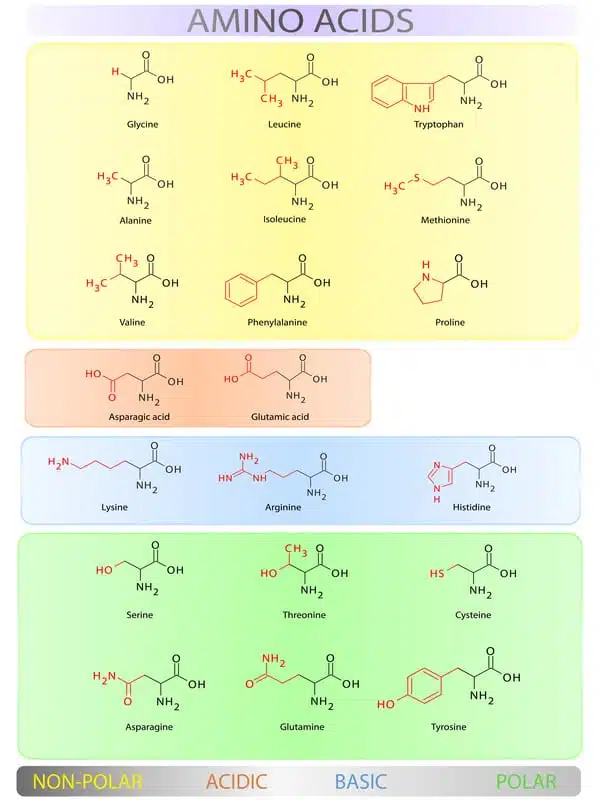
Short answer/definition:
An amino acid mix is a defined combination of free amino acids that is specifically used to support skin and hair function. Amino acids are the smallest building blocks of proteins and an essential component of the skin’s natural moisturizing factors (NMF). In cosmetic formulations, they primarily have a moisture-binding, barrier-supporting, and structure-stabilizing effect. Their effect is predominantly functional and depends on the concentration, pH value, and galenic system.
What are amino acids in cosmetics?
Amino acids are organic compounds that are used as free molecules or as components of protein hydrolysates.
They occur naturally in the stratum corneum of the skin and contribute to water binding, pH buffering, and enzyme function.
What role do amino acids play in the Natural Moisturizing Factor (NMF)?
Amino acids account for about 40–50% of the NMF.
Serine, glycine, alanine, and PCA are particularly relevant because they have a hygroscopic effect and reduce transepidermal water loss (TEWL).
How does an amino acid mix affect the skin?
An amino acid mix improves moisture retention and supports the skin’s barrier function.
In-depth information – typical effects:
- Increased skin elasticity through better hydration
- Support of enzymatic processes in the stratum corneum
Reduction of feelings of tightness in dry skin.
Which amino acids are most important in skin care?
The importance of individual amino acids varies and is based on their function.
| Amino Acid | Primary Function in the Skin |
| Glycine | Moisture binding, structural protein building block |
| Serine | Component of the Natural Moisturizing Factor (NMF), barrier support |
| Alanine | Osmoregulation |
| Proline | Collagen-associated amino acid |
| Arginine | pH buffering, skin conditioning |
In-depth information: In practice, these amino acids are used as a balanced amino acid mix to replicate the natural ratio of NMF.
How do amino acids differ from peptides or proteins?
Amino acids are individual building blocks, peptides are short chains, and proteins are long chains.
In-depth information: Amino acids have a predominantly physical-functional effect, peptides often act as signaling molecules, and proteins are hardly able to penetrate the skin.
What is the significance of amino acids in hair care?
In hair care, amino acids have a structure- and moisture-regulating effect.
In-depth: They attach themselves to damaged keratin structures and improve:
- Combability
- Elasticity
- Moisture retention in the cortex.
Which amino acids are relevant for hair and scalp care?
Not all amino acids are equally relevant for skin and hair.
| Amino Acid | Relevance |
|---|---|
| Cysteine | Keratin structure, disulfide bond formation |
| Arginine | Scalp microcirculation support, pH buffering |
| Lysine | Hair fiber stability |
| Histidine | Metal ion chelation, antioxidant properties |
In-depth information: In shampoos and tonics, amino acids are generally used in concentrations of 0.1–1.0%.
What are the limitations of using amino acids in cosmetic products?
Amino acids are not active ingredients with pharmacological effects.
In-depth information – clear limitations:
– No structural regeneration of deep skin tissue
– No direct anti-aging effect
– Effect depends on regular use
How are amino acids formulated?
Amino acids are water-soluble and pH-sensitive.
In-depth information – step by step:
- Selection of free amino acids or standardized mixtures
- Adjustment of the pH range (typically 4.5–6.5).
- Testing of salt and surfactant compatibility.
- Stability testing over 12–24 months.
How are amino acids classified in terms of regulations?
Amino acids are approved for use in cosmetics without restriction in the EU.
In-depth information:
- INCI names must be declared individually.
- Not listed in Annex II–VI of Regulation (EC) No. 1223/2009.
- Safety assessment is carried out on a product-specific basis by a certified safety assessor.
What requirements apply to safety and product assessment?
Amino acids must be toxicologically evaluated and exposed.
In mixtures, each amino acid must be considered individually. Synergistic effects are not to be assumed, but must be functionally justified.
For a quick market entry, Tojo Cosmetics offers immediately available, EU-compliant white label products in which amino acid mixtures are already formulated.
For individual production orders, Cosactive offers formulation-tested amino acid mixtures and individual amino acids, even in small quantities.
FAQ
What is an amino acid mixture?
An amino acid mixture is a defined combination of free amino acids for functional skin or hair care.
Are amino acids active ingredients in the legal sense?
No, they are considered skin or hair conditioning ingredients.
Can amino acids reduce wrinkles?
No, they primarily improve hydration and skin function.
Are amino acids suitable for sensitive skin?
Yes, with the correct dosage and pH adjustment.
Are amino acids also permitted in natural cosmetics?
Partially, depending on their origin and certification standard.
Do amino acids have to be declared individually in the INCI?
Yes, each amino acid used must be listed individually.