Allergen-Free Perfumes: The Answer to the New Fragrance Allergen Regulation
Hardly any ingredient shapes the perception of a cosmetic product as much as its fragrance—and hardly any other is the subject of such intense regulatory scrutiny. After nickel, fragrances are among the most common triggers of contact allergies; EU estimates suggest that between one and nine percent of the European population is sensitized to specific fragrances. In response, the European Commission has adopted Regulation (EU) 2023/1545, expanding the list of fragrance allergens subject to declaration from 26 to over 80 substances—the first transition period ends as early as July 31, 2026.
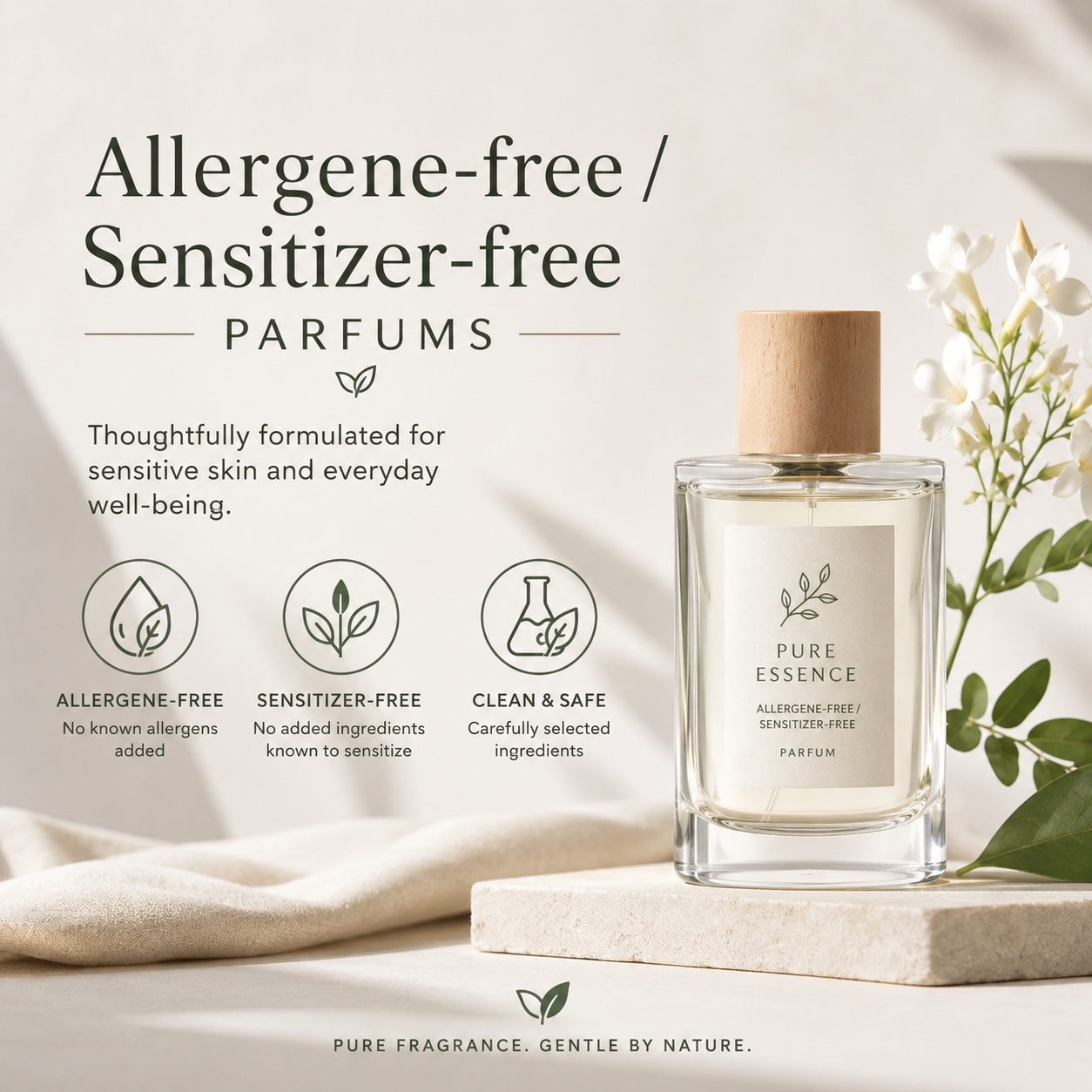
This raises a strategic question for brands and manufacturers: How can a product remain sensorially appealing without excluding sensitive consumers and without overloading the INCI list with allergens? One of the most compelling answers is allergen-free fragrances. Together with specialized fragrance partners, Cosmacon supports brands through this very transition—and one such partner, with its own collection of sensitizer-free fragrance compositions, has demonstrated a way to ensure that none of the more than 80 regulated sensitizers are present above the detection limit.
In this article, we present this collection along with fragrance descriptions, list the new allergens individually, and explain why allergen-free perfumes are among the most important formulation trends of the coming years.
Why the Demand for Allergen-Free Cosmetics Is Growing
The market for sensitive skin and body care has been growing at an above-average rate for years. More and more consumers describe their skin as sensitive, dermatologists are seeing a persistently high number of fragrance-induced contact dermatitis cases, and independent consumer magazines consistently downgrade products containing fragrance allergens that are subject to mandatory labeling in their product tests. Until now, manufacturers have essentially had only two options: either a completely fragrance-free product—which is often a sensory compromise, since even raw materials have their own natural odor that needs to be balanced or masked—or a traditionally fragranced product with a correspondingly long list of declared allergens. Allergen-free fragrances fill precisely this gap: they enable a rich, emotional fragrance profile without a single fragrance ingredient subject to declaration appearing on the INCI list.
This is particularly relevant for product categories where skin compatibility is a key purchasing factor: baby care and diaper-area products, sensitive skin lines for the face and body, medical skincare and pharmacy cosmetics, intimate care, as well as all products aimed at performing well in independent product tests. In the private-label sector as well, retailers are increasingly seeking out formulations with allergen-free fragrances to differentiate themselves on the shelf with a robust skin-friendly promise.
Regulation (EU) 2023/1545: The New List of Fragrance Allergens
Regulation (EU) 2023/1545 was published on July 26, 2023, and entered into force on August 15, 2023. It amends Annex III of the EU Cosmetics Regulation 1223/2009 and significantly expands the list of fragrances that must be individually listed in the ingredients list if their concentrations exceed certain thresholds. Previously, 26 fragrance allergens were subject to declaration requirements—including well-known substances such as Linalool, Limonene, Citral, Geraniol, and Coumarin. Based on an expert opinion from the Scientific Committee on Consumer Safety (SCCS), 56 additional substances were identified and added to Annex III.
Key details at a glance: Labeling is required starting at 0.001% (10 ppm) in leave-on products (creams, perfumes, hair styling products) and at 0.01% (100 ppm) in rinse-off products (shower gel, shampoo, soap). Products newly placed on the market as of July 31, 2026, must comply with the new requirements; for products already on the market, the deadline for compliance is July 31, 2028. After that date, regulatory authorities may order the recall of products bearing the old labeling.
The 56 new fragrance ingredients subject to declaration, in detail
The regulation includes both individual fragrance molecules and numerous natural essential oils and extracts.
Individual substances now subject to declaration: Acetyl Cedrene, Amyl Cinnamal, Amyl Salicylate, Amyl Cinnamyl Alcohol, Anise Alcohol, Anethole, Benzaldehyde, Benzyl Alcohol, Benzyl Benzoate, Benzyl Cinnamate, Benzyl Salicylate, Butyl Phenyl Methylpropional, Camphor (Campher), Carvone, Beta-Caryophyllene, Cinnamal, Cinnamyl Alcohol, Citral, Citronellol, Coumarin, Dimethyl Phenethyl Acetate, Eugenol, Eugenyl Acetate, Farnesol, Geraniol, Geranyl Acetate, Hexadecanolactone, Hexamethylindanopyran, Hexyl Cinnamal, Hydroxycitronellal, Hydroxyisohexyl 3-Cyclohexene Carboxaldehyde, alpha-Isomethyl Ionone, Isoeugenol, Isoeugenyl Acetate, Limonene, Linalool, Linalyl Acetate, Menthol, Methyl 2-Octynoate, 6-Methyl Coumarin, methyl salicylate, pinene, 3-propylidene phthalide, rose ketones, salicylaldehyde, santalol, sclareol, alpha-terpinene, terpineol, terpinolene, tetramethyl acetylocta-hydronaphthalenes, trimethylbenzenepropanol, trimethylcyclopentenyl methylisopentenol, and vanillin.
Essential oils and plant extracts now subject to declaration requirements: Cananga odorata oil/extract (ylang-ylang), Cedrus atlantica oil/extract (Atlas cedar), Cinnamomum cassia leaf oil and Cinnamomum zeylanicum bark oil (cinnamon), Citrus aurantium flower oil (neroli), Citrus aurantium peel oil (bitter orange), Citrus aurantium bergamia peel oil (bergamot), Citrus limon peel oil (lemon), Eucalyptus globulus oil (eucalyptus), Eugenia caryophyllus oil (clove), Evernia furfuracea extract (tree moss) and Evernia prunastri extract (oak moss), jasmine oil/extract (jasmine), Juniperus virginiana oil (Virginia cedar), Laurus nobilis leaf oil (bay leaf), Lavandula oil/extract (lavender), Lemongrass Oil (lemongrass), Lippia Citriodora Absolute (lemon verbena), Mentha Piperita Oil (peppermint) and Mentha Viridis Leaf Oil (spearmint), Myroxylon Pereirae Oil/Extract (Peru balsam), Narcissus Extract (daffodil), Pelargonium graveolens flower oil (rose geranium), Pinus mugo (mountain pine) and Pinus pumila (dwarf pine), Pogostemon cablin oil (patchouli), rose flower oil/extract (rose), Santalum album oil (sandalwood), and turpentine.
In addition, so-called prehaptenes and prohaptenes—substances that only become known contact allergens through air oxidation or bioactivation—are considered equivalent and are subject to the same labeling requirements. Existing entries have also been clarified, for example by adding isomers and aligning CAS and EC numbers.
The Tightrope Walk for Manufacturers: The Declaration Paradox
For cosmetics manufacturers, this creates a real tightrope walk. On the one hand, there is the legitimate desire for greater transparency and consumer protection; on the other, the concern that this very transparency will unsettle customers. After all, the regulation affects not only new products—it also has a massive impact on existing ones.
The key point: Many of the new allergens are natural components of plant extracts and essential oils. If they are detectable in these ingredients at levels above the thresholds, they must be declared individually in the future—even if nothing in the formulation has changed. For an existing product containing natural lavender, citrus, or rose oil, this could suddenly mean that five, ten, or even more additional potential allergens become subject to declaration. The INCI list, which consumers have been familiar with for years, will grow overnight to include a whole host of unfamiliar-sounding substance names.
“Why did you change my product? Take these allergens out again!”
The natural reaction of many consumers to their long-time favorite product is predictable: “Why did you change my product? Take these allergens out again!” For suppliers, this is the worst-case scenario—because nothing has actually changed. The product is identical to yesterday’s; the substances have always been present. The only thing that’s new is the requirement to list them.
This communication task—explaining an unchanged product with a suddenly much longer list of allergens without losing consumer trust—is one of the greatest challenges of the coming years. On top of that, fragrance suppliers must conduct significantly more analyses, distributors must provide significantly more documentation, and the expanded INCI lists simply require more space on the packaging. As a result, products are likely to become more expensive.
This is exactly where allergen-free fragrances come in: Those who rely on sensitizer-free fragrance compositions for a sensitive-skin relaunch or a new product development avoid the declaration paradox from the outset. The INCI list remains concise, the promise of skin compatibility is analytically verifiable—and there is no cascade of allergens on the label that requires explanation.
What exactly does “sensitizer-free” mean?
Cosmacon’s fragrance partners define their sensitizer-free compositions using a clear analytical criterion: None of the more than 80 sensitizers listed in Regulation (EU) 2023/1545 is present above the detection limit of 10 ppm. As a result, the formulations fall below even the strict “leave-on” threshold—eliminating the need for specific allergen declarations in every product category.
Important for accurate communication: Allergen-free fragrances do not guarantee that individual intolerances are completely ruled out—such a claim would also be prohibited under the Claims Regulation (EU) No. 655/2013. However, they ensure that none of the fragrances scientifically classified and regulated as contact allergens are present in relevant quantities. For claims such as “free of fragrance allergens subject to declaration,” they provide a robust, analytically verifiable basis.
It is noteworthy that three of the following formulations are offered as 100% natural variants. This is technically challenging from a formulation standpoint, as natural raw materials and essential oils, in particular, naturally contain high levels of linalool, limonene, or citral. Natural allergen-free fragrances therefore require an extremely targeted selection of raw materials—and open up entirely new possibilities for certified natural cosmetics.
An Overview of the Sensitizer-Free Fragrance Collection
The current collection from a Cosmacon partner (as of 09/2025) includes eleven fragrance profiles for personal care—ranging from green and fresh to floral and fruity. Six compositions are new to the portfolio, three of which are entirely of natural origin:
| Fragrance Composition | Fragrance Description | Item Code |
|---|---|---|
| Aloe Flower | fresh, leafy-green, aldehydic, azalea, apple, pear, cosmetic, woody | P0242267 |
| Apple & Eve | fruity, ripe, apple, characteristic | P0228489 |
| Balmy Blossom(100% natural) NEW | fresh, floral, cosmetic, transparent, eucalyptus, balsamic, powdery, cedarwood, sandalwood | P0252724 |
| Blue Temptation | fresh, citrusy, fruity, aquatic, floral, musky | P0228185 |
| Cucumber Care(100% natural) | fresh, green, characteristic | P0252062 |
| MeadowFresh NEW | fresh, citrusy, green, leafy, earthy, herbaceous, coniferous, minty, floral, musky, amber | P0242358 |
| Med Sensitive | aldehydic, green, floral, cosmetic, creamy, fruity, sandalwood, amber | P0242505 |
| PamperingFlowers NEW | fresh, floral, azalea, magnolia, lilac, cosmetic, woody, cedarwood, sandalwood, amber, musk | P0242630 |
| PinkBloom NEW | fresh, floral, peach blossom, rose, green, fruity, peach, cosmetic, woody, musk | P0242625 |
| RoseEssence NEW | floral, fresh, rose, classic | P0273854 |
| Tender Touch(100% natural) NEW | floral, fresh, eucalyptus, mint, orchid, azalea, cosmetic, creamy, balsamic, woody, musk | P0252725 |
This range demonstrates that allergen-free fragrances are no longer a compromise in terms of sensory experience: Med Sensitive offers a classic, creamy fragrance for sensitive and medical care; Cucumber Care and Meadow Fresh cater to the green-fresh trend in natural cosmetics and men’s grooming; while Pink Bloom, Pampering Flowers, and Rose Essence enable feminine, floral concepts. Fruity profiles like Apple & Eve are ideal for family and children’s care products.
From Fragrance Selection to the Final Formulation
A sensitizer-free fragrance composition is only half the battle—the other half is the formulation in which it is used. Fragrances interact with emulsifiers, surfactants, and active ingredients; dosage, stability, and sensory interactions must be tested on a product-specific basis. A comprehensive safety assessment (CPSR) also remains mandatory: A product containing allergen-free fragrances undergoes the same safety evaluation, stability testing, and compatibility testing as any other cosmetic. The advantage lies elsewhere—in the streamlined INCI list, a stronger starting position in consumer tests, and a tolerability claim that can be analytically substantiated.
This presents concrete opportunities for brands: relaunches of existing lines as “sensitive” versions, new developments in baby and children’s care, dermocosmetic concepts for pharmacies and specialty retailers, or certified natural cosmetics with natural, allergen-free fragrances. And last but not least: Anyone planning new products now—in the midst of the transition phase for Regulation (EU) 2023/1545—can elegantly resolve the issue of allergen labeling from the outset, rather than having to explain extended INCI lists later on.
FAQ – Frequently Asked Questions
What are allergen-free fragrances?
Fragrance compositions that contain none of the more than 80 fragrance allergens subject to declaration under Regulation (EU) 2023/1545 in concentrations exceeding the detection limit of 10 ppm. They therefore do not need to be declared by name as allergens in any product category—only “Parfum” appears on the INCI list.
Why are more allergens suddenly being declared in existing products that haven’t been changed?
Because many of the 56 new allergens are natural components of essential oils and plant extracts. If they are detectable above the threshold levels, they must be listed individually in the future—even without a change to the formulation. A product that has remained identical for years can thus suddenly have five to ten or more additional allergens listed on the label overnight. Nothing has changed; the only new requirement is the obligation to declare them.
What does Regulation (EU) 2023/1545 cover?
It expands Annex III of the EU Cosmetics Regulation 1223/2009 and increases the number of fragrance allergens subject to declaration from 26 to over 80—including natural oils and extracts. The labeling requirement applies starting at 0.001% in leave-on products and at 0.01% in rinse-off products. Products newly placed on the market must be compliant as of July 31, 2026; existing stock must be compliant by July 31, 2028.
Are there allergen-free fragrances available for natural cosmetics as well?
Yes. The Cosmacon partner portfolio includes three compositions of 100% natural origin: Balmy Blossom, Cucumber Care, and Tender Touch—a unique feature, as natural raw materials often contain high levels of linalool or limonene.
Can a product with a sensitizer-free fragrance be marketed as “hypoallergenic”?
Only with supporting evidence. Claims such as “hypoallergenic” must be substantiated in accordance with Regulation (EU) No. 655/2013. More legally sound are precise statements such as “free of fragrance allergens subject to declaration,” supported by the fragrance supplier’s analysis and the product-specific safety assessment.
Conclusion: Fragrance and skin compatibility are no longer a contradiction. Would you like to develop a sensitive-skin product with allergen-free fragrance or protect an existing product from the declaration paradox? Cosmacon develops your custom formulation—from fragrance selection through stability and compatibility testing to the final safety report. If you need a faster solution: Tojo Cosmetics offers innovative white-label concepts that can be enhanced with sensitizer-free fragrance compositions. Contact us!