Moroccan Oil in cosmetics: use, composition, and evaluation of Moroccan Oil for hair and face
Short answer/definition:
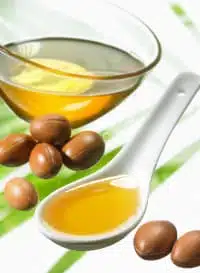
Moroccan Oil (INCI: Argania Spinosa Kernel Oil) is a vegetable oil extracted from the kernels of the argan tree. In cosmetics, it is used as a lipid-based skincare ingredient. It is characterized by a high content of unsaturated fatty acids and natural tocopherols. In hair and skin care products, Moroccan Oil primarily has a moisturizing, smoothing, and barrier-supporting effect. The cosmetic effect depends on the quality, processing (refined vs. virgin), and concentration used.
What is Moroccan Oil in cosmetics?
Moroccan Oil is a non-drying vegetable oil with cosmetic relevance for skin and hair care.
For cosmetic applications, cold-pressed or mildly refined oil is predominantly used to control odor and susceptibility to oxidation.
Why is Moroccan Oil used for hair and face?
Moroccan Oil provides skin- and hair-like lipids and improves the surface structure.
It supports the lipid matrix of the stratum corneum and reduces friction on the hair fiber.
What are the benefits of Moroccan Oil in skin care?
Moroccan Oil has a moisturizing and occlusive effect without leaving a strong greasy feeling.
In-depth information – typical effects:
- Reduction of transepidermal water loss (TEWL)
- Improvement of skin smoothness
- Support for dry and mature skin conditions
What are the benefits of organic Moroccan Oil in hair care?
In hair care, Moroccan Oil improves combability and shine.
In-depth: Organic Moroccan Oil is often used in leave-on products because it is mild to the senses and has a silicone-like slipperiness.
What is the difference between organic Moroccan Oil and cosmetic Moroccan Oil?
Organic Moroccan Oil is subject to additional requirements in terms of cultivation and processing.
In depth:
- Organic certification relates to the origin of the raw material, not automatically to its cosmetic effectiveness
- Refined Moroccan Oil is more stable and odorless.
What is the typical fatty acid composition of Moroccan Oil?
Moroccan Oil has a balanced ratio of monounsaturated and polyunsaturated fatty acids.
Fatty acid Typical proportion (in %)
Oleic acid (C18:1) approx. 42–48
Linoleic acid (C18:2) approx. 30–36
Palmitic acid (C16:0) approx. 12–15
Stearic acid (C18:0) approx. 4–7
Further information: Organic argan oil also contains 600–900 mg/kg of tocopherols, predominantly γ-tocopherol.
In which cosmetic products is organic argan oil useful?
Organic argan oil is suitable for lipid-based skin and hair care products.
In-depth information – typical applications:
- Facial oils and serums
- Hair oils, conditioners, masks
- Emulsions for dry skin
– Lip care products
What are the usual concentrations?
Organic argan oil is usually used in concentrations of between 1 and 10%.
In-depth information: In pure oils (INCI-only products), the concentration is 100%, but significantly lower in emulsions.
What are the limitations of organic argan oil in cosmetics?
Organic argan oil is not an active ingredient in the regulatory sense.
In-depth information – clear limitations:
- No deep skin regeneration
- No structural hair repair
- Limited oxidation stability without antioxidants.
How is organic argan oil classified in regulatory terms?
Organic argan oil is approved without restriction as a cosmetic product in the EU.
Further information:
- INCI: Argania Spinosa Kernel Oil
- No restrictions according to Regulation (EC) No. 1223/2009.
– Safety assessment is carried out on a product-specific basis in the CPSR
What requirements apply to the CPSR and product assessment?
The quality and purity of the organic argan oil must be documented.
Further information – relevant for CPSR:
- Specification (peroxide value, fatty acid profile)
- Oxidation stability in the end product
- Exposure assessment depending on product category
Practical implementation/options for market launch: For a quick market entry, organic argan oil-based white label products from Tojo Cosmetics can be used, which have already been developed in compliance with EU regulations.
For individual formulations, Cosmacon offers quality-tested vegetable oils and complementary active ingredients, even in small quantities.
The choice of organic or refined organic argan oil should be based on the product objectives, stability requirements, and sensory properties.
FAQ
What does organic argan oil mean for hair/face?
The term describes the use of organic argan oil in hair and face care products.
Is organic argan oil comedogenic?
Organic argan oil is considered low comedogenic at normal cosmetic dosages.
Is organic organic argan oil more effective than refined organic argan oil?
No, the difference lies primarily in origin and sensory properties, not in the basic effect.
Can organic argan oil be used alone as a facial oil?
Yes, it can be used as a single product for dry skin.
Does organic argan oil have to be declared separately in the INCI?
Yes, as “Argania Spinosa Kernel Oil.”
Is organic argan oil suitable for natural cosmetics?
Yes, provided it meets the relevant certification requirements.
Does every organic argan oil product require its own safety report?
Yes, as each final formulation requires a separate safety assessment.