Aronia
Aronia – the power of black berries
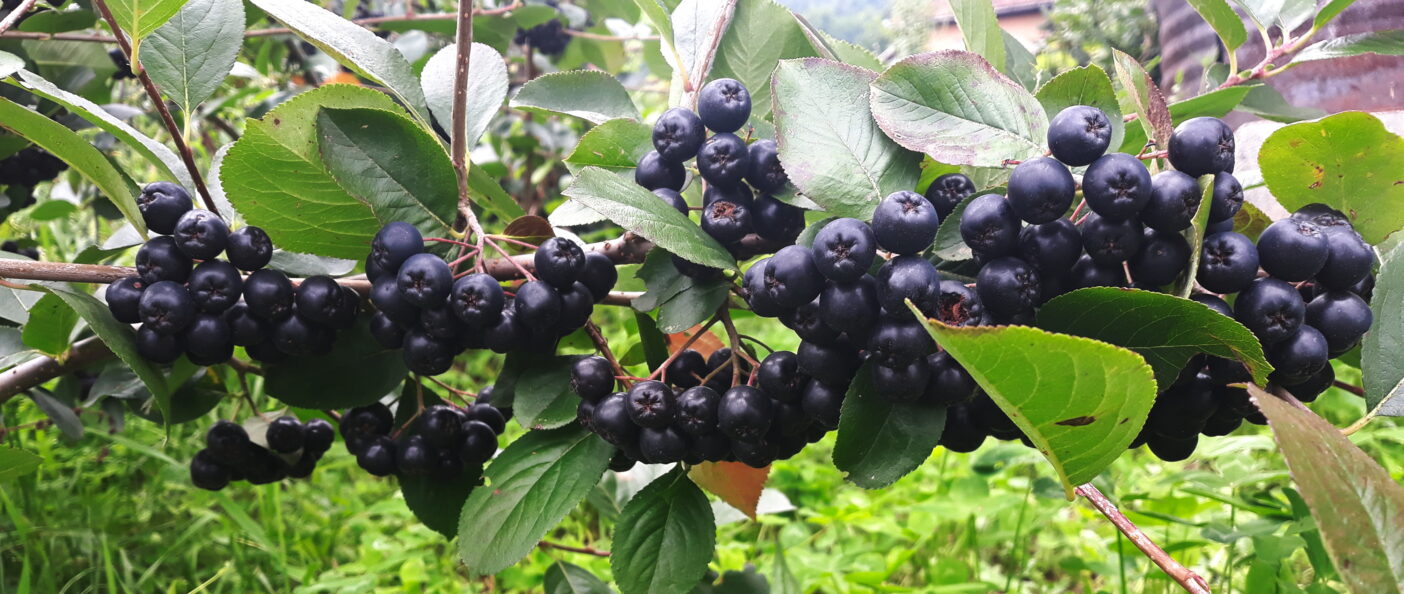
Originally from eastern North America, the aronia berry is now also well known in Europe. In English, it is called chokeberry – a reference to its tart, sour, astringent taste. Aronia is valued both as a dietary supplement and in cosmetics, primarily because of its exceptionally high content of antioxidants and flavonoids. In addition, numerous studies have been conducted on its potential health benefits.
Botany of aronia
The deciduous aronia shrub reaches a height of one to three meters. In winter, its pointed, wine-red buds are striking. During the flowering period, ten to twenty white to pale pink flowers grow together in dense inflorescences. The ripe fruits are pea-sized, red-black in color, and contain a multi-seeded core.
There are three types of aronia (chokeberry):
- Felted chokeberry (Aronia arbutifolia)
- Black chokeberry (Aronia melanocarpa)
- *Aronia × prunifolia
The most widespread are Aronia arbutifolia and Aronia melanocarpa.
Cultivation and special features
In Germany, aronia is mainly cultivated in Saxony, Brandenburg, and Bavaria. In 2019, the harvest amounted to around 1,100 tons. Cultivation is also established in Austria and Switzerland, with an annual harvest of around 1,500 tons. Aronia has been used in fruit cultivation since the beginning of the 20th century, initially mainly in Russia, where it was grafted onto rowan and medlar trees.
The seeds of the berries contain amygdalin, a cyanogenic glycoside. However, the hydrocyanic acid content of fresh fruit is within the safe range at 0.6–1.2 mg per 100 g. Heating further reduces this content, so regular consumption is considered safe.
All aronia species are characterized by a high resistance to diseases, pests, and UV radiation. This is due to the high flavonoid and anthocyanin content in the skin.
Anthocyanins – protective substances in aronia
Anthocyanins belong to the flavonoid group and are water-soluble plant pigments that give all red, blue, and purple fruits their color. They are particularly concentrated in aronia. That is why aronia berries are also used as a natural alternative to synthetic food colorings such as cochineal red.
Anthocyanins protect the plant from:
- free radicals
- UV radiation
- fungi and microorganisms
The berries also contain tannins and bitter compounds that repel predators. These protective mechanisms also make aronia interesting for humans.
Aronia in scientific studies
Several studies suggest that aronia extracts have medicinal potential, for example as an anti-carcinogenic agent or for alleviating the side effects of chemotherapy and radiation therapy.
- In vitro, aronia extracts inhibited the growth of colon cancer cells by up to 50% within 48 hours – more effectively than extracts from blueberries or grapes.
- Aronia reduced tumor growth by inhibiting the enzyme COX-2.
- Polyphenols from aronia showed inhibitory effects in vitro on breast, colon, cervical, and leukemia cancer cells.
- In vivo, activation of the enzyme CEACAM1, which has a tumor-inhibiting effect, was observed.
In addition, aronia is being researched for its antidiabetic effects, regulatory effect on platelet formation, and possible neuroprotective properties. Clinical studies are still pending in some cases, but the berry is considered promising.
Aronia as a dietary supplement
Aronia berries contain:
- Flavonoids and anthocyanins
- Folic acid
- Provitamin A
- Vitamins B (except B12), C, E, and K
- Bitter compounds and tannins
This gives aronia real superfood potential. In situations of increased stress—such as stress, illness, or intense exercise—the body’s own antioxidant protection can be overwhelmed. This is where aronia can help.
The antioxidant potential in a test tube is higher than that of blueberries, cranberries, or lingonberries. Even if this does not automatically mean higher bioavailability, aronia impresses with its broad profile of vital substances.
Supporting recovery after exercise
Exercise strengthens the immune system, cardiovascular health, and mental well-being. However, studies show that excessive stress can increase susceptibility to infection.
After intense physical activity, the number of short-term defense cells decreases significantly—especially in competitive athletes.
Aronia can support regeneration after exercise:
- Reduction of oxidative stress
- Anti-inflammatory effects
- Support for the immune system
A Polish study showed that aronia juice significantly reduces oxidative stress after exercise. Aronia also protects cells from UV-induced damage during outdoor sports.
Consumption and quality
Fresh aronia berries are available from the end of August and can be eaten raw. Due to their tart taste, they are often processed into juice, jelly, jam, or purée.
Recommended amounts:
- Approximately 100 ml of aronia syrup daily
- or 15 g of dried berries
Important factors:
- Certified organic cultivation
- Gentle processing
- Short transport routes
- No added synthetic vitamins
Exaggerated advertising claims should be viewed critically: Aronia is healthy, but it is not a substitute for medical therapy.
Aronia in cosmetics
Thanks to its high content of antioxidant flavonoids, vitamins, and minerals, aronia is also used in cosmetics. Its following properties are particularly valued:
- Antioxidant and anti-inflammatory properties
- Astringent and antibacterial effects
- Barrier-strengthening effects
Aronia is suitable for:
- Anti-aging and anti-pollution products
- UV protection and after-sun care
- Care for dry, thin, or itchy skin
- Products for blemished skin
- Hair care for shine, volume, and improved combability
Aronia profile
Other names: Black chokeberry, bald aronia
INCI: Aronia Melanocarpa Fruit Extract
Extraction: Extract
Main components:
Flavonoids, anthocyanins, bitter compounds and tannins, vitamins A, B, C, E, K, folic acid, magnesium, potassium, calcium, iron, zinc
Effect: Antioxidant, anti-inflammatory
Cosmetic applications:
Face and eye care, serums, masks, sun protection, after-sun, hand and lip care, hair care products
Conclusion: The power of black berries
The aronia berry combines resilience, regenerative capacity, and an exceptionally dense profile of protective substances. Its anthocyanins, combined with bitter compounds, tannins, vitamins, and minerals, make it a versatile active ingredient for nutrition and cosmetics.
Cosmacon specifically uses these properties to develop high-quality cosmetics and sophisticated natural cosmetics—for skin and hair care based on scientifically proven plant-based active ingredients. Contact us!
Literature:
Kulling, S. E., & Rawel, H. M. (2008). Chokeberry (Aronia melanocarpa): A review on the characteristic components and potential health effects. Planta Medica, 74(13), 1625–1634. DOI: 10.1055/s-0028-1088306
Gajić, D., et al. (2020). Chokeberry (Aronia melanocarpa) fruit extract modulates immune response in vitro and in vivo.Journal of Functional Foods, 66, 103802. DOI: 10.1016/j.jff.2020.103802
Pilaczyńska‑Szcześniak, Ł., Skarpańska‑Steinborn, A., et al. (2005). The influence of chokeberry juice on oxidative stress and antioxidant capacity in rowers. International Journal of Sport Nutrition and Exercise Metabolism, 15(1), 48–58. PMID: 15902989