
Upcycled Beauty – Conserves Resources and Creates Added Value
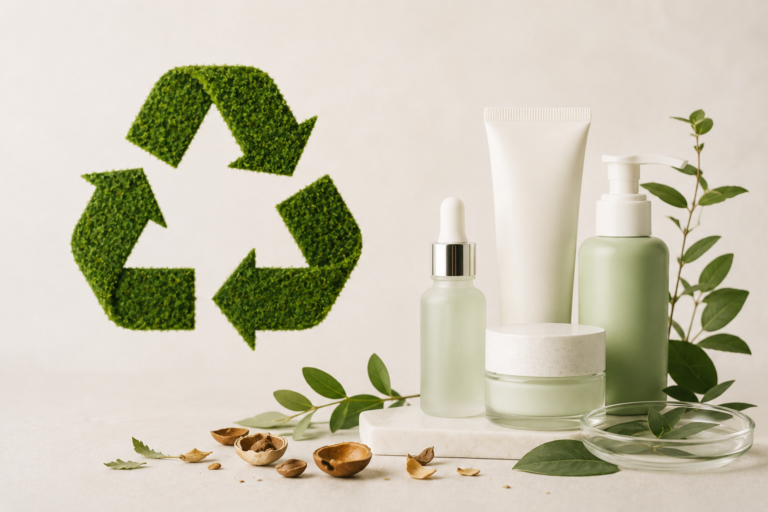
The term upcycling was coined as early as 1994 by engineer and interior designer Reiner Pilz. In an interview, he said:
“Any form of reuse and repurposing is to be welcomed, because it not only stimulates the imagination but also helps conserve important resources.”
It is precisely this idea that is gaining increasing importance in the cosmetics industry today.
What Does “Upcycled Beauty” Mean?
Although recycling and upcycling are often equated, they differ fundamentally.
In recycling, materials are usually processed mechanically or chemically before being reused.
Upcycled Beauty takes a different approach: High-quality byproducts or waste materials are used directly as new raw materials and are thereby upgraded. Valuable ingredients are preserved, while waste is avoided at the same time.
Raw materials for upcycling include byproducts from the food, fragrance, cosmetics, and wood industries, as well as from agriculture.
Why Upcycled Beauty Is Sustainable
Upcycled Beauty offers numerous environmental benefits:
- Conservation of natural resources
- Reduction of CO₂ emissions
- Waste prevention
- Lower energy consumption
- Better utilization of existing raw materials
According to the European Union, approximately 500 kg of municipal waste is generated per capita annually, about half of which is of biological origin. Many of these materials still contain valuable ingredients and are ideally suited for cosmetic applications.
Numerous upcycled raw materials also meet important requirements of modern cosmetics. They are often:
- COSMOS-compliant,
- vegan,
- preservative-free,
- China-compliant, and
- sustainably sourced.
Upcycled Beauty – High-Quality Raw Materials Instead of Waste
Many byproducts from fruits, vegetables, or plants still contain large amounts of antioxidants, polyphenols, fatty acids, vitamins, or dietary fiber and are therefore far too valuable to be discarded.
Examples include:
- used coffee grounds containing caffeic acid and chlorogenic acid for anti-cellulite products,
- fruit pits containing omega-3 and omega-6 fatty acids,
- citrus peels for extracting essential oils,
- wood scraps for natural fragrances,
- fruit purees or flower residues for perfume compositions,
- fruit pits or wood chips as biodegradable exfoliants.
Even the condensate produced during apple juice production is now used in high-quality skincare products.
Examples of Successful Upcycled Beauty
More and more companies are turning to upcycled raw materials.
TechnicoFlor extracts essential oils from discarded carrot seeds, sawdust, rose petals, clementine peels, or residues from wine and cognac production.
Laboratoires Expanscience processes avocados that cannot be exported into active ingredients for eye care and also uses byproducts from passion fruit and lupine processing.
Seiwa Kasei uses silk scraps from textile production as a moisturizing alternative to animal collagen.
Mibelle Biochemistry uses the silver skin of coffee beans. The active ingredient derived from it strengthens the skin barrier, reduces transepidermal water loss, and has a soothing effect.
J. Rettenmaier & Söhne develops biodegradable exfoliating particles from apple and orange peels as a sustainable alternative to microplastics.
Symrise has developed SymFerment®, a postbiotic derived from the fermentation supernatants of Lactobacillus cultures. This active ingredient supports filaggrin formation, improves skin hydration, and strengthens the skin barrier.
Lucas Meyer Cosmetics uses byproducts from the production of natural fragrances. The Wastar™ line provides skin-soothing and antioxidant active ingredients for skin and scalp care.
Upcycled Beauty Is the Future
Upcycled Beauty impressively demonstrates that sustainability and high-quality cosmetics are not mutually exclusive.
Through the intelligent use of existing raw materials, resources are conserved, CO₂ emissions are reduced, and, at the same time, innovative active ingredients with high cosmetic efficacy are obtained.
As Reiner Pilz aptly put it:
“The limits of upcycling are set only by people’s imagination.”
More and more companies today are proving that high-quality cosmetics can be created from what are supposedly waste materials. Upcycled Beauty combines sustainability, innovation, and effectiveness—making it an important component of modern skincare.
Cosmacon is happy to support you in developing innovative cosmetic products using high-quality upcycled raw materials and sustainable active ingredient concepts. Contact us!
When you need a quick solution:
✨ Our partner Tojo Cosmetics offers innovative, active-ingredient-rich private-label products—quickly available, high-quality, and perfect for brands that want to impress with passion and quality.