Acetyl Tetrapeptide 11 – An innovative active ingredient for firm and youthful skin
Introduction
Peptides are becoming increasingly important in modern skin care. One of the most innovative active ingredients in this field is Acetyl Tetrapeptide 11. This bioactive peptide has the potential to improve skin structure, increase skin firmness, and support a youthful appearance. Particularly noteworthy is its ability to promote the synthesis of syndecan-1, which strengthens cell adhesion and the skin barrier.
This article highlights the origin, mode of action, advantages, and disadvantages of acetyl tetrapeptide 11 and also provides ideas for cosmetic formulations that can contain this unique active ingredient.
What is acetyl tetrapeptide 11?
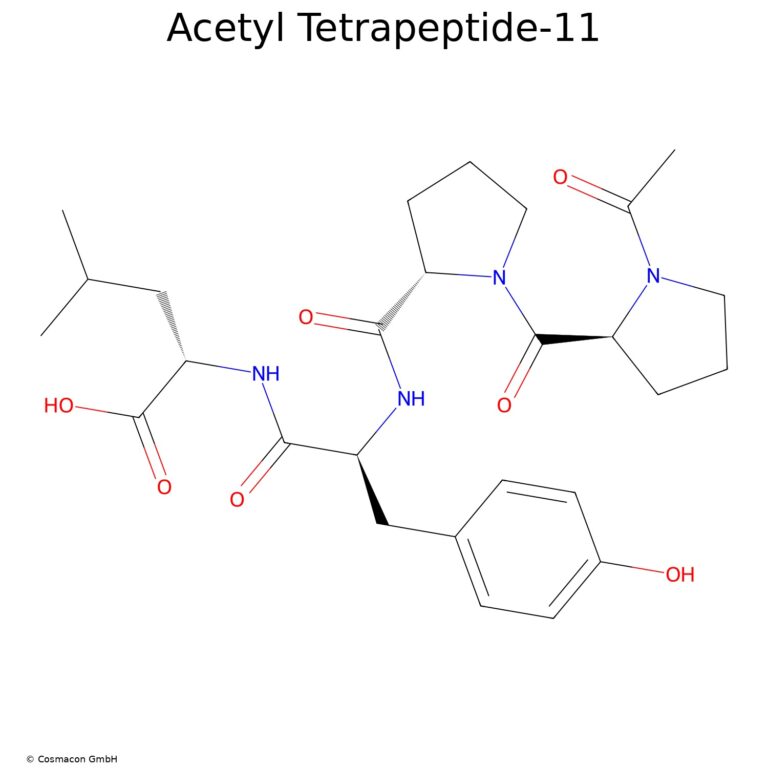
Acetyl tetrapeptide 11 is a synthetic peptide that has been specially developed for cosmetic applications. It consists of four amino acids that together exert a specific biological activity. The main function of this active ingredient is to improve skin structure by stimulating the synthesis of syndecan-1, an important cell adhesion molecule. This strengthens the connection between the skin layers, resulting in improved skin elasticity and firmness.
Physical and chemical properties of Acetyl Tetrapeptide-11
INCI name: Acetyl Tetrapeptide-11
Alternative names: Creapep® Acetyl Tetrapeptide-11
CAS number: 928006-88-6
Molecular formula: N/A (peptides have variable molecular formulas)
Appearance: White to off-white powder
Purity: ≥98.0%
Physical state: Solid
Recommended concentration: 0.000105–0.0165%
Solubility: Water-soluble
Mechanism of action: Promotes syndecan-1 synthesis to strengthen cell adhesion and skin barrier
Manufacture and extraction
Acetyl tetrapeptide 11 is produced using synthetic peptide technology. This involves linking individual amino acids in a specific order to create a peptide with specific bioactive properties.
Tidetron Bioworks, one of the leading manufacturers, uses an environmentally friendly biotechnological production method with high purity and sustainability. This reduces waste products and environmental pollution often associated with chemical synthesis.
Effect and scientific findings
How does Acetyl Tetrapeptide 11 affect the skin?
Acetyl Tetrapeptide 11 has impressive anti-aging effects, particularly through its strengthening effect on the epidermis-dermis connection. The main mechanisms are:
- Promotion of syndecan-1 synthesis:This improves cell adhesion and strengthens the skin’s barrier function.
- Increasing skin firmness and elasticity:Improved cell cross-linking makes the skin firmer.
- Reducing fine lines and wrinkles:Through its restructuring effect on the skin matrix.
Efficacy studies and recommended concentration
Studies show that acetyl tetrapeptide 11 in concentrations between 0.000001% and 1.0% can already cause significant improvements in skin structure. Optimal results in terms of skin tightening and firming were observed particularly in serums and creams with a concentration of 0.1–0.5%.
Benefits of acetyl tetrapeptide 11
The benefits of this active ingredient make it an ideal addition to high-quality anti-aging products:
- Improves skin structure:Strengthens the skin barrier and increases firmness.
- Promotes cell adhesion:Improves communication between skin cells.
- Increases skin elasticity:Supports the skin’s natural elasticity.
- Reduces fine lines and wrinkles:For smoother and more youthful skin.
- Well tolerated:No known side effects, also suitable for sensitive skin.
- Biotechnological production:Sustainable and environmentally friendly.
Disadvantages of Acetyl Tetrapeptide 11
Despite its numerous advantages, there are some potential disadvantages:
- Relatively high production costs:As it is a specialized peptide, the production costs are higher than for conventional active ingredients.
- Effect depends on the formulation:The optimal effect is only achieved in certain cosmetic formulations with the right peptide stabilization.
- Lack of long-term studies:Although initial studies are promising, there are still no long-term studies spanning decades.
Possible uses in cosmetic products
Acetyl tetrapeptide 11 is particularly suitable for anti-aging products and can be used in various formulations:
- Anti-aging serums
- Highly concentrated serums with acetyl tetrapeptide 11
- Combination with hyaluronic acid and niacinamide for intensive skin care
- Firming face creams
- Ideal for mature skin to improve skin elasticity and density
- Can be combined with ceramides and peptides such as palmitoyl tripeptide-1
- Eye care products
- Reduces fine lines and crow’s feet
- Can be combined with caffeine and vitamin K to reduce dark circles under the eyes
- Firming body care
- Body lotions with a firming effect
- Ideal for neck, décolleté, and hand creams
- Special care for sensitive skin
- Fragrance-free formulations for people with sensitive skin
- Can be combined with soothing ingredients such as allantoin and panthenol
Conclusion
Acetyl Tetrapeptide-11 is an innovative active ingredient with great potential for firming and anti-aging cosmetic products. Through its ability to stimulate syndecan-1, it improves skin elasticity, strengthens the skin barrier, and reduces fine lines and wrinkles.
Its good tolerability and biotechnological production make it a sustainable alternative for modern skin care products. Although the production costs are high, acetyl tetrapeptide 11 impresses with visible results and innovative mechanisms of action.
Cosmacon GmbH offers customized formulations with Acetyl Tetrapeptide-11 to strengthen your brand with highly effective and innovative cosmetic products. Let’s develop high-quality and sustainable skin care products together!
When products are needed quickly:
✨ Our partner Tojo Cosmetics offers innovative, active ingredient-rich private label products – quickly available, high quality and perfect for brands that want to impress with passion and quality.